Direct Answer: GSM (grams per square metre) is the weight of one square metre of fabric. In spunbond polypropylene (PP) it decides how stiff, opaque and durable a non-woven bag feels, and how much material it uses.
Start at 80 GSM for reusable shopping bags — it is also the New York minimum for a reusable bag made of non-film material (6 NYCRR 351-1.2). No single GSM suits every bag.
Handles, seams and bag style decide as much as fabric weight, so confirm any GSM with a load test on a sample of your own bag.
This guide explains what GSM measures in non-woven bag raw material, how to match it to bag style and regulations, what it does to material use, how to verify it on arrival, and what to send us for a quote. For the full sourcing process, start with our non-woven bag buying guide.
Planning a non-woven bag order?
Tell us the bag style, size and heaviest load through the inquiry form at the end of this guide. We can quote two or three GSM and construction options so you can compare samples side by side.
- 1. What GSM measures in non-woven bag raw material
- 2. GSM tiers and typical bag roles
- 3. Why bags fail before the fabric does
- 4. How bag style changes the GSM you need
- 5. What GSM does to material use and non-woven bag price
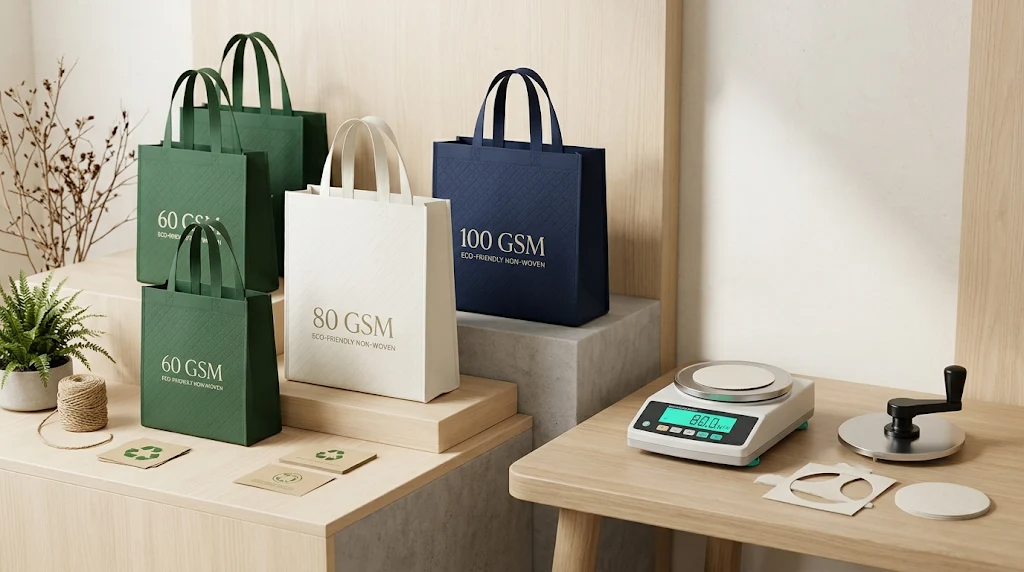
- 6. How to verify the GSM you receive
- 7. Reusable-bag rules and environmental claims
- 8. Choosing GSM by use case
- 9. What EcoLeaderPack can supply
- 10. FAQ
- 11. Sources
What GSM measures in non-woven bag raw material
GSM means grams per square metre (g/m²), also called mass per unit area. For non-wovens, the reference test method is ISO 9073-1:2023: cut specimens of known area, weigh them, and convert to g/m². North American specifications sometimes use ounces per square yard. Because 1 oz = 28.3495 g and 1 yd² = 0.8361 m², 1 oz/yd² ≈ 33.91 g/m², so 80 GSM is about 2.36 oz/yd².
Most non-woven bags are made from spunbond (spunlaid) polypropylene. These non-woven polypropylene fabrics are the main non-woven bag material in our own range, alongside RPET (recycled PET) and PLA (polylactic acid, a plant-based polymer). The trade association EDANA describes the process in three steps:
- Extrusion: polymer granules are melted and extruded through spinnerets into filaments.
- Web forming: the continuous filaments are stretched and quenched, then laid on a conveyor belt as a uniform web.
- Calender bonding: heated rollers apply heat and pressure to weld the web together. This gives spunbond its dotted or diamond surface pattern.
More GSM means more polymer in every square metre. The fabric becomes thicker, more opaque and stiffer, and every bag uses more material. Strength is a separate property. It is measured with tests such as the grab test for breaking strength (ASTM D5034) and the falling-pendulum tear test (ASTM D1424). It also depends on filament quality and bonding, not on GSM alone.
GSM tiers and typical bag roles
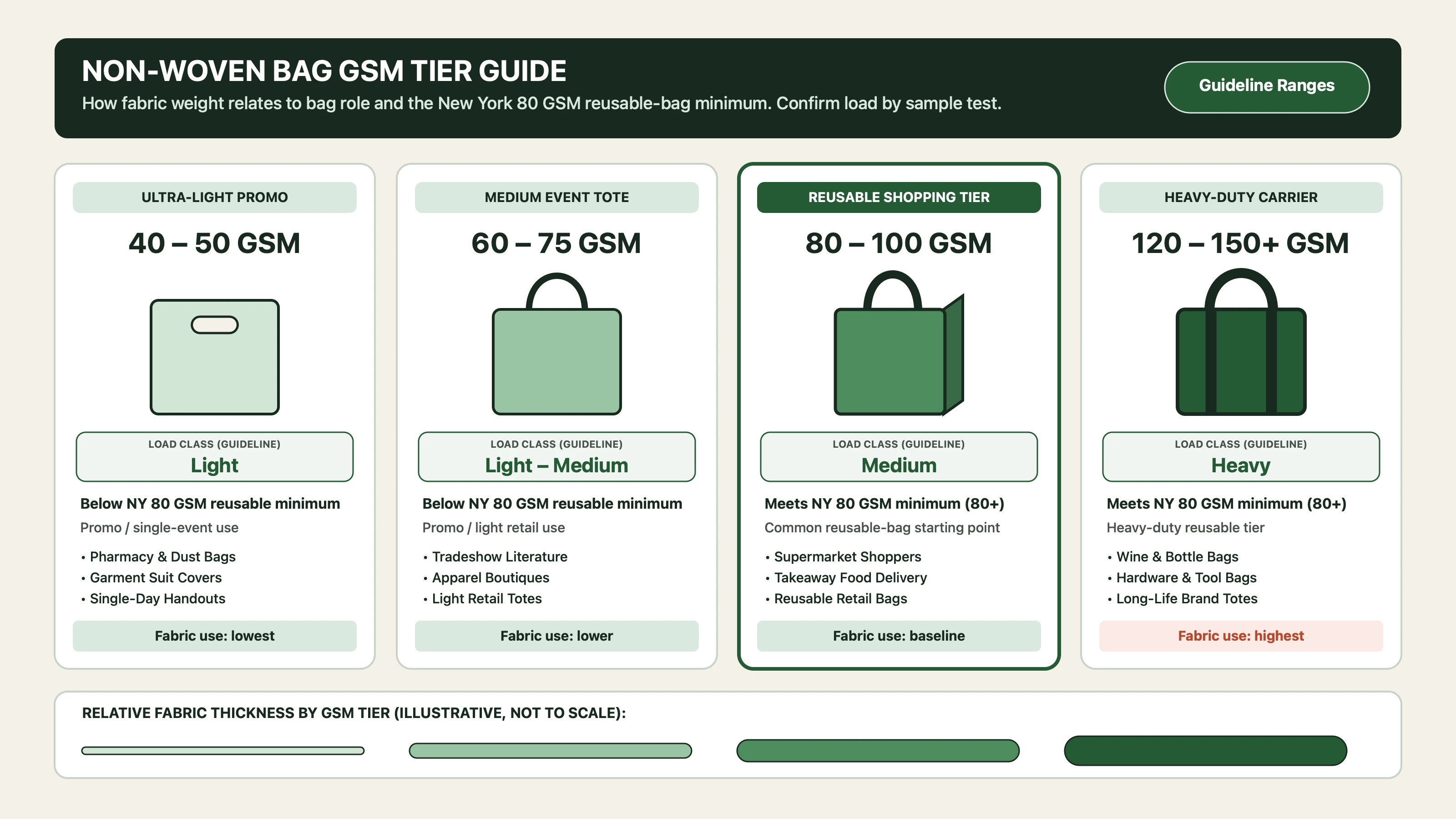
The table shows how buyers commonly match GSM to a bag role, and where each tier sits against New York's 80 GSM reusable-bag minimum. It does not give a payload per GSM, because payload depends on handle attachment, seams, bag size and the shape of the load. A gusset is a folded side or bottom panel that lets the bag stand up.
| Fabric weight | Typical role | Typical bag styles | Load class (guideline) |
|---|---|---|---|
| 40–50 GSM | Single-event handouts, pharmacy and dust bags, garment covers — below the NY 80 GSM minimum | W-cut, drawstring pouch, garment cover | Light |
| 60–75 GSM | Tradeshows, apparel boutiques, light retail — below the NY 80 GSM minimum | D-cut, W-cut, simple sewn tote | Light to medium |
| 80–100 GSM | Non-woven grocery tote bags, takeaway delivery, reusable retail bags — meets the NY 80 GSM minimum | Sewn tote, gusset (box) tote, reinforced-handle tote | Medium |
| 120–150+ GSM | Wine and bottle bags, hardware, large non-woven tote bags for long-life branding — meets the NY 80 GSM minimum | Reinforced sewn tote, divided wine bag | Heavy |
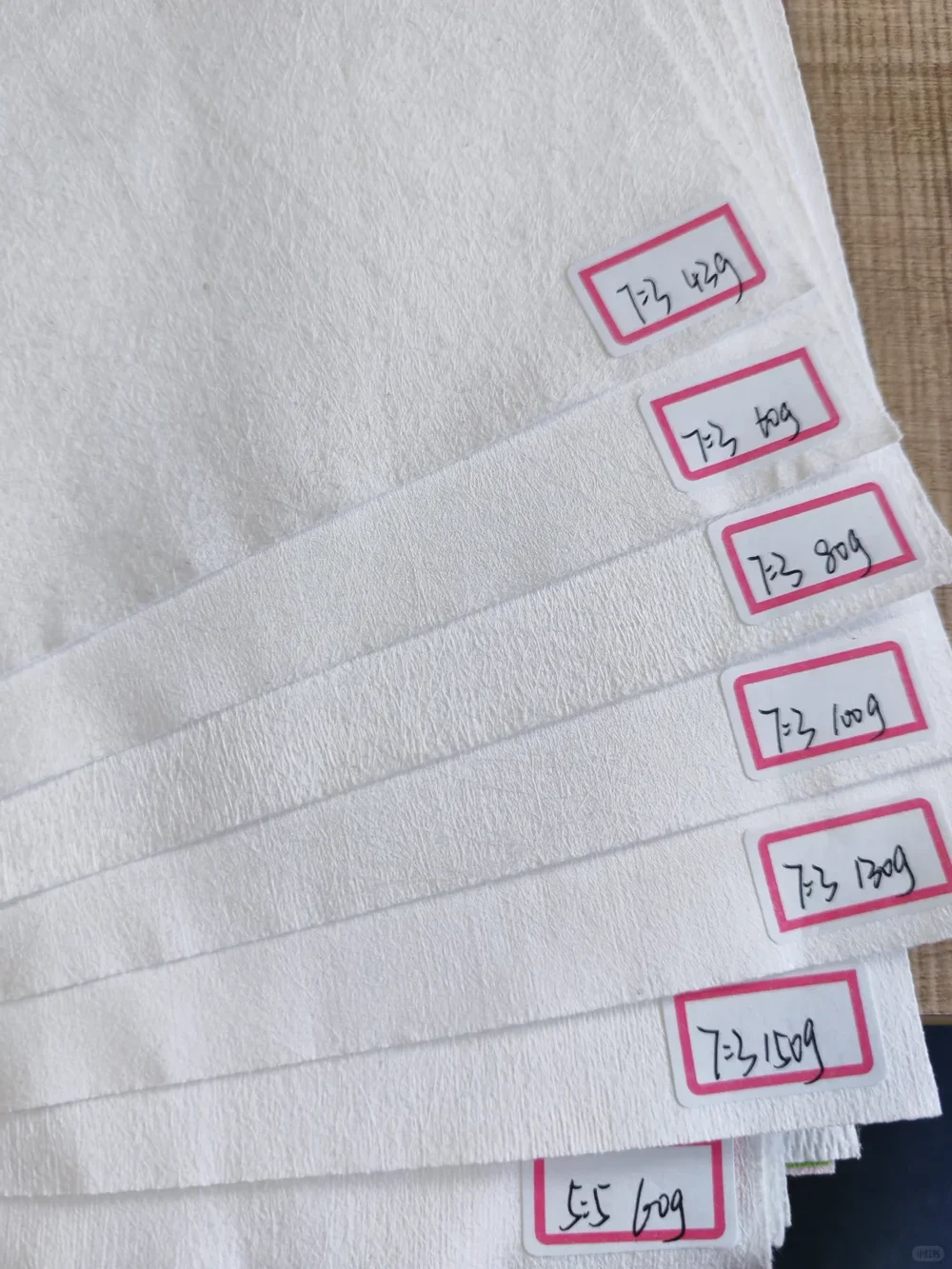
Weights between tiers, such as 110 GSM, sit between the two neighbouring roles. Our standard production range is 60–120 GSM; lighter and heavier fabrics are in our 42–150 GSM swatch range, so ask us if your bag needs one (product page).
Fabric weight has a manufacturing tolerance. In our production it is generally held within ±5 GSM of the specified weight, so an 80 GSM order typically measures 75–85 GSM. Agree the acceptable range in the purchase order, and see section 6 for how to check it.
Why bags fail before the fabric does
A loaded bag puts its whole load on a few attachment points, and lifting, swinging and setting it down add shock to the static weight. That is why problems usually start at the handle root, the bottom seam or a puncture, rather than in the middle of the fabric. It is also why New York's whole-bag test checks the finished bag, not only the fabric.
| Weak point | What happens | What to specify |
|---|---|---|
| Handle root | The handle peels or tears away from the body under repeated lifting | Sewn handles with a boxed or X-box stitch through a folded hem for heavier bags; ultrasonic handles (heat-sealed without stitching) for lighter, high-volume bags |
| Bottom seam and corners | Heavy items press on the base and pull the seam apart | A gusseted base, edge binding or a base board where goods are heavy |
| Puncture and tear | A sharp corner pierces the fabric and the tear then spreads | Heavier or laminated fabric, or packing rigid items away from the bag wall |
Breaking strength and tear strength are different properties with different test methods: ASTM D5034 for grab breaking strength and ASTM D1424 for tearing strength. If your goods have hard corners, ask for tear data on the fabric as well as the GSM.
How bag style changes the GSM you need
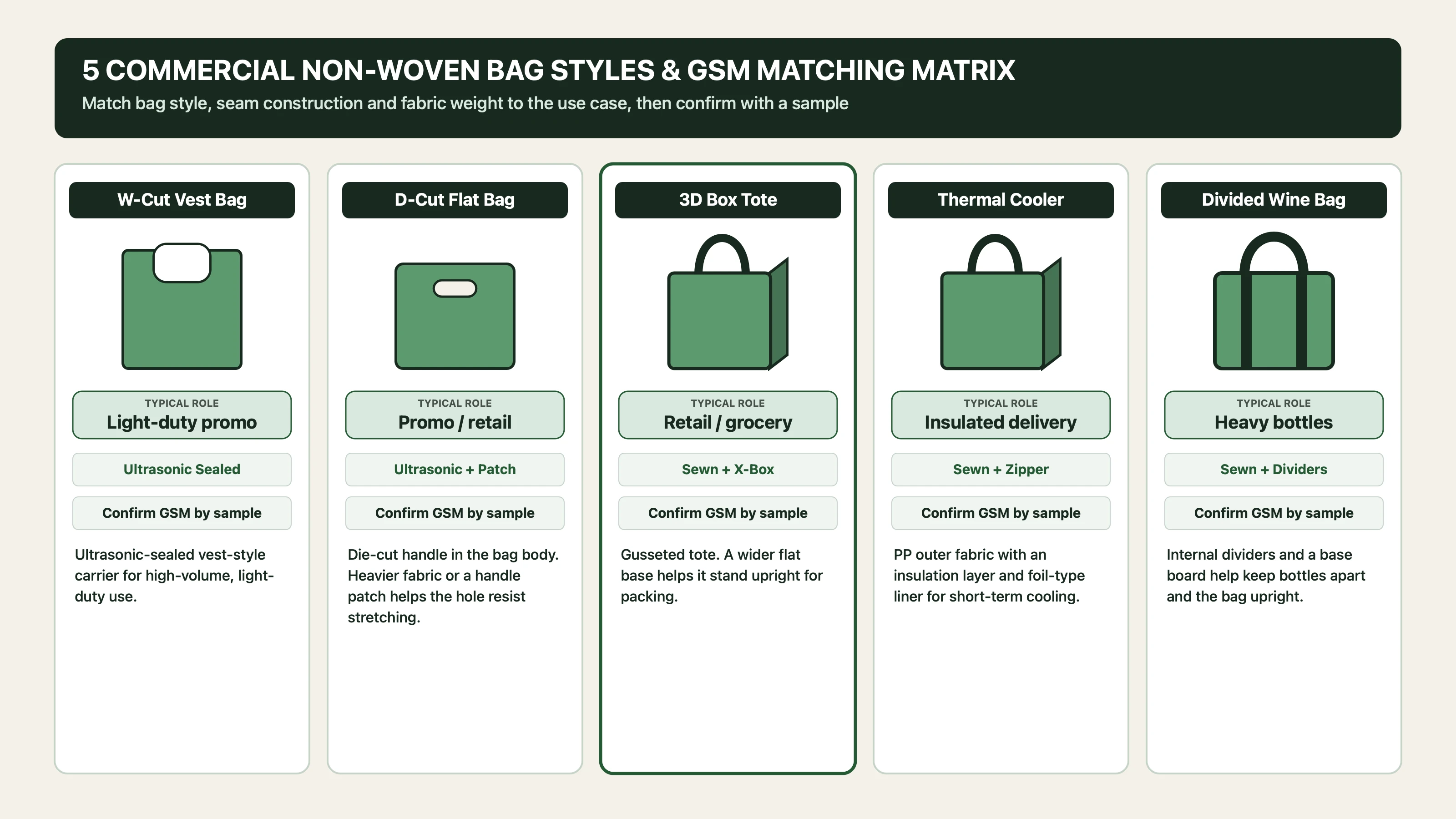
The same non-woven bag material behaves differently in different constructions. Choose the style first, match the GSM to it, then confirm with a sample.
| Bag style | Typical construction | What it means for GSM |
|---|---|---|
| W-cut bag | Ultrasonic-sealed, vest-style handle cut from the body | Often made lighter for promotions and giveaways. Below 80 GSM it does not meet New York's fabric minimum for a reusable bag. |
| D-cut bag | Ultrasonic-sealed, handle hole die-cut in the body | The hole sits in the body fabric, so heavier fabric or a handle patch helps it resist stretching. |
| Box (gusset) tote | Sewn, with side and bottom gussets | A wide base helps the bag stand upright. Stiffness matters, so many buyers start at 80 GSM and above. See our box non-woven bags. |
| Cooler / insulated bag | Outer non-woven fabric, insulation layer and liner, sewn with a zipper | The insulation adds stiffness, so the outer fabric weight is chosen together with the insulation spec. See our insulated non-woven bags. |
| Wine / bottle bag | Sewn, with internal dividers and an optional base board | Glass bottles concentrate load and knock together. Heavier fabric, dividers and a base board are the usual protection. |
What GSM does to material use and non-woven bag price
Fabric weight changes how much material goes into every bag. You can estimate it with one line of arithmetic:
The table below shows material use, not price — heavier fabric uses more material, but the price also depends on printing, quantity and packing.
Total cut area (m²) × GSM = fabric weight per bag (g)
For a gusset tote, the cut area includes the front and back panels, side gussets, base, handles, and hem and seam allowances. Your pattern sets the exact area.
Worked example, for illustration only: a bag with a total cut area of 0.60 m².
| Fabric weight | Fabric per bag | Compared with 80 GSM |
|---|---|---|
| 70 GSM | 0.60 × 70 = 42 g | 12.5% less fabric |
| 80 GSM | 0.60 × 80 = 48 g | Baseline |
| 100 GSM | 0.60 × 100 = 60 g | 25% more fabric |
Actual prices also depend on the polypropylene market, construction, printing, quantity and packing, so we quote each specification separately.
Heavier fabric also takes more carton space, so ask for the carton size and CBM for each GSM option when you compare quotes. Moving up in GSM without a reason adds material and freight cost; moving down without a check risks returns.
How to verify the GSM you receive
A few GSM of difference cannot be judged by hand, which makes fabric weight easy to under-deliver. Two checks catch most problems: measure the actual GSM, and check whether the fabric contains mineral filler.
- Cut a known area. Use a circular sample cutter to punch several 100 cm² (0.01 m²) swatches (112.8 mm diameter) from unprinted areas of the bag body, away from seams and hems. Take them from different bags and cartons. Follow the specimen requirements of ISO 9073-1:2023.
- Weigh and convert. Weigh each swatch on a laboratory balance and multiply the grams by 100. A 0.800 g swatch is 80 GSM. Compare the average with the GSM and tolerance written in the purchase order. Our standard tolerance is ±5 GSM.
- Test ash content if filler is a concern. Calcium carbonate is used as a filler in PP spunbond fabric (see, for example, US Patent 12,168,843, Higher strength calcium carbonate filled fiber spunbond and SMS nonwoven material). Filler counts towards the measured GSM but is not PP fiber, so a fabric can reach its target weight with less polymer. ASTM D5630-22 measures the inorganic ash left after burning a plastic sample; ask a laboratory to test the fabric against a known virgin-PP control. A sharp fold that leaves a chalky white crease is a common quick screen, but it is not a standard test.
Agree the GSM tolerance, the test method and what happens if a lot falls outside tolerance before production starts. Write them into the purchase order or the pre-shipment inspection checklist.
Reusable-bag rules and environmental claims
- New York: 80 GSM is the minimum for a reusable bag. The regulation (6 NYCRR 351-1.2) defines a reusable bag as one designed for multiple reuses, with a minimum lifespan of 125 uses (each use carrying at least 22 pounds over at least 175 feet), at least one separately attached strap or handle that does not stretch, washable, and with a minimum fabric weight of 80 GSM for bags made of non-film plastic, including woven or non-woven polypropylene (regulation text; Colligan Law summary, 2020).
- California: plastic checkout bags are banned from 1 January 2026. SB 1053 (Chapter 453, Statutes of 2024) was signed on 22 September 2024 (LegiScan). From 1 January 2026, grocery stores, pharmacies, liquor and convenience stores may no longer give out plastic checkout bags, including thicker "reusable" film bags. Recycled paper bags may only be provided at checkout for at least US$0.10, and the law encourages shoppers to bring their own reusable bags (Packaging Insights, 9 Dec 2025). Check the chaptered text for the bag standard that applies to your product before you supply this market.
- European Union: PPWR sets packaging rules, and generic green claims are restricted. Regulation (EU) 2025/40 (PPWR) sets packaging requirements across the EU; see our PPWR 2026 preparation guide. Separately, Directive (EU) 2024/825 restricts generic environmental claims such as "eco-friendly" or "biodegradable" unless the trader can demonstrate the claimed environmental performance. Its rules have applied since 27 September 2026. For PP bags, describe the bag as reusable and avoid generic green wording.
Reuse is what makes the environmental case: a non-woven PP bag must be used at least 11 times to have a lower global warming potential than a conventional HDPE carrier bag that is not reused — or 14 times if the HDPE bag is reused as a bin liner. A cotton bag needs 131 uses. Source: the UK Environment Agency's life cycle assessment of supermarket carrier bags (report SC030148, February 2011) (GOV.UK).
Choosing GSM by use case
| Use case | Where to start | What to confirm on a sample |
|---|---|---|
| Supermarket and grocery shoppers | 80 GSM or above, sewn or box tote with reinforced handles | Loaded handle test, base stability, washing if sold as reusable |
| Takeaway and delivery | Box tote with a wide base, or an insulated bag for hot or cold food | Fit of your stacked containers, handle comfort, base width |
| Tradeshows and events | Lighter D-cut or W-cut bags | Print clarity, handle comfort, carton size |
| Apparel, gift and cosmetics retail | Box tote, optionally laminated for print and water resistance | Opacity, print finish, handle style |
| Wine, spirits and heavy goods | 120 GSM and above with dividers and a base board | Bottle spacing, base support, handle root under full load |
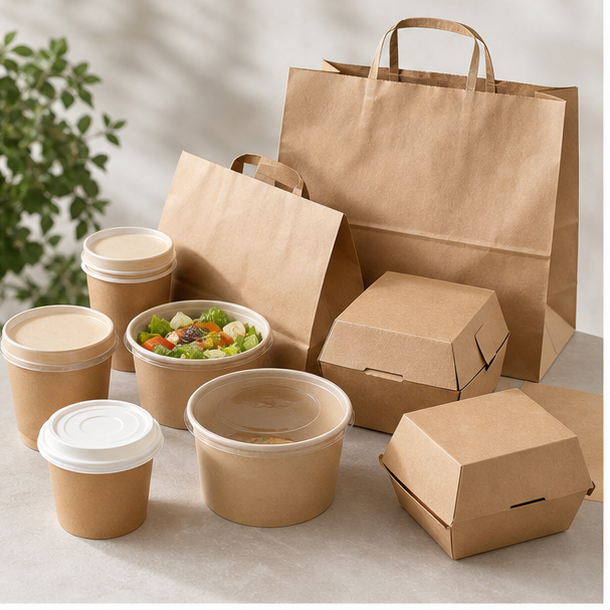
For coordinated restaurant packaging, see our takeaway and delivery packaging range. If you are comparing fabric with paper, the selection criteria differ; see our paper bags. For a balanced view of the material itself, read the pros and cons of non-woven bags.
What EcoLeaderPack can supply
The figures below are from our custom non-woven bags page. Lead time and MOQ for your own specification are confirmed in the quotation.
| Item | What we offer |
|---|---|
| Materials | PP, recycled RPET and PLA; glossy or matte lamination (a thin plastic film over the print) |
| Fabric weight | Standard production 60–120 GSM; 42–150 GSM swatch range for sampling |
| MOQ | From 1,000 pcs, depending on style and customization |
| Sampling | 5–7 days |
| Bulk production | 7–15 days for standard styles after sample approval |
| Styles | Stitched totes (standard, bottom gusset, front pocket, reinforced handle) |
| Ultrasonic D-cut, W-cut and gusset bags | |
| Laminated totes | |
| Drawstring bags | |
| Foldable totes | |
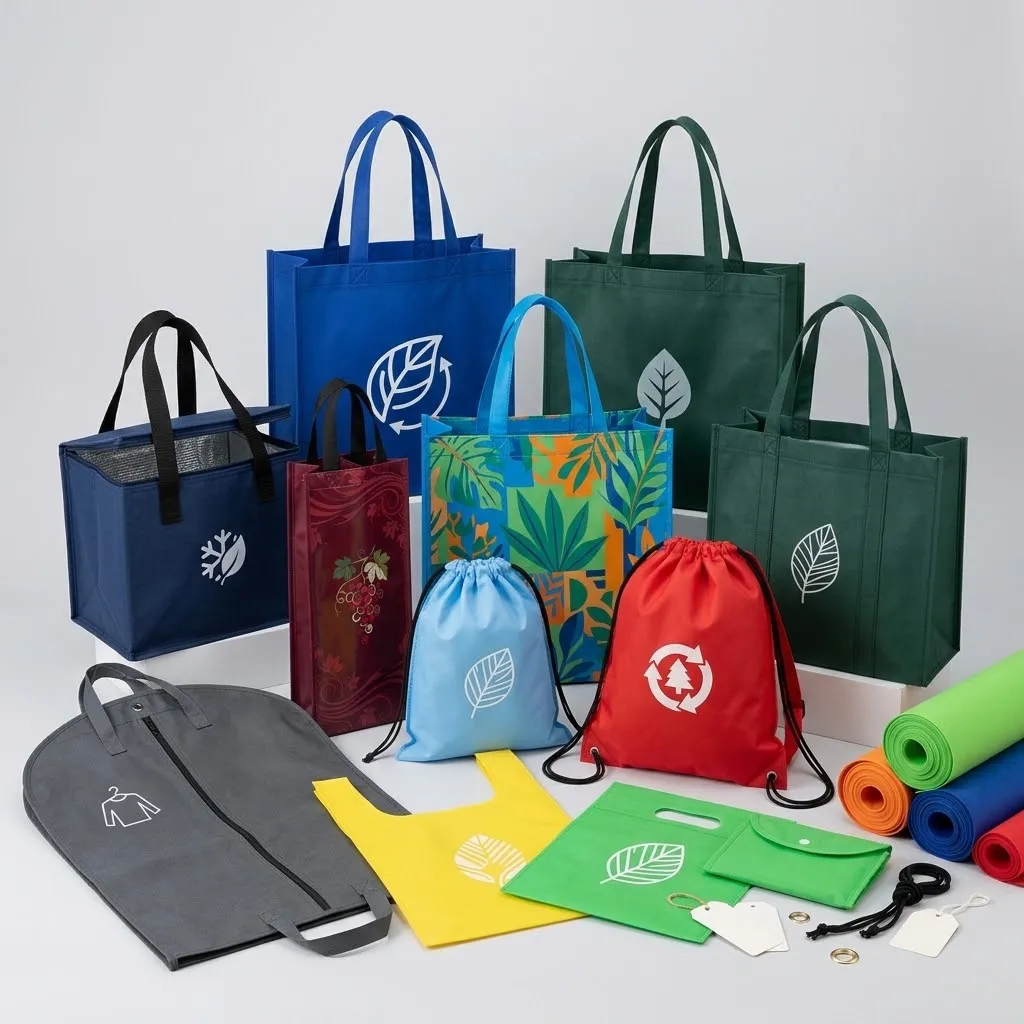
| Wine, cooler, garment and gift bags | |
| Printing | Screen printing, heat transfer, digital printing and laminated printing |
| Handles and add-ons | Sewn, heat-sealed, rope or webbing handles; X-stitched handles; lining, pocket, base board, zipper, Velcro or snap closures |
Our product page notes that typical promotional bags carry 5–10 kg, and that higher GSM or reinforced styles carry more. Treat this as a guide and test a sample of your own design.
To get a useful quote the first time, include:
- Bag style, and a reference picture or sample if you have one.
- Width, gusset, height and handle length.
- What the bag will carry, and the heaviest load you expect.
- The GSM you are considering, or the markets where reusable-bag rules apply.
- Logo artwork, number of colours, print positions and any lamination.
- Quantity per design and destination port.
Frequently asked questions
What GSM is common for reusable shopping bags?
80 GSM is a common starting point. It is also the minimum fabric weight in New York's definition of a reusable bag made of non-film material such as non-woven polypropylene (6 NYCRR 351-1.2). Whether 80 GSM is enough for your bag depends on its handles, seams and load, so test a sample.
How much weight can an 80 GSM non-woven bag hold?
It depends on how the bag is built. New York's whole-bag test (see section 7) checks the finished bag, not just the fabric, and a bag has to be built and tested to that standard, not just made from 80 GSM fabric. Our product page gives 5–10 kg as typical for promotional bags. Ask us to load-test a sample of your size and handle type.
Is a sewn handle stronger than an ultrasonic handle?
Sewn handles with a boxed or X-box stitch spread the load over more fabric, so they are the usual choice for heavier or longer-life bags. Ultrasonic handles suit lighter, high-volume bags. To compare them for your order, pull-test samples made from the same fabric.
How can I check that the supplier did not reduce the GSM?
Cut several 100 cm² swatches from unprinted areas, weigh them, multiply by 100, and compare the average with the tolerance in your purchase order. If filler is a concern, add an ash content test under ASTM D5630-22. See section 6.
What is 80 GSM in oz per square yard?
About 2.36 oz/yd². One ounce per square yard equals about 33.91 g/m².
Is a non-woven PP bag biodegradable?
No. A 2025 review in Molecules describes conventional PP and PE as non-biodegradable polyolefins that persist for decades or longer (Fakhrizada & Dahman, 2025). The environmental case for a PP bag rests on reuse: the UK Environment Agency found it needs at least 11 uses to beat a single-use HDPE carrier bag on global warming potential.
Related reading
- Non-woven bag buying guide: the full procurement overview.
- Pros and cons of non-woven bags: a balanced view before you commit to the material.
- PPWR 2026 preparation guide: EU packaging rules.
Request a GSM Recommendation & Samples
Send us your bag style, size and heaviest load, and we will suggest two or three GSM and construction options, with carton size for each so you can compare freight. You can also message us on WhatsApp (+86 155 2109 3069) or browse our custom non-woven bags.
All fields marked with an asterisk (*) are required. We reply within 24 hours.
Sources
All links checked on 5 November 2026.
- New York State, 6 NYCRR 351-1.2, definitions including "reusable bag": law.cornell.edu.
- Colligan Law, "DEC Releases Final Plastic Bag [Regulations]…", 19 February 2020: insights.colliganlaw.com.
- California SB 1053 (2023–2024), Chapter 453, Statutes of 2024, bill status and text: legiscan.com.
- Packaging Insights, "California ends plastic checkout bags and raises paper standards", 9 December 2025: packaginginsights.com.
- Regulation (EU) 2025/40 on packaging and packaging waste (PPWR): eur-lex.europa.eu.
- Directive (EU) 2024/825, empowering consumers for the green transition: European Commission, Transition Pathways.
- UK Environment Agency, Life cycle assessment of supermarket carrier bags: a review of the bags available in 2006, report SC030148, February 2011: GOV.UK (PDF).
- ISO 9073-1:2023, Nonwovens test methods, Part 1: determination of mass per unit area: iso.org.
- ASTM D5034, breaking strength and elongation of textile fabrics (grab test): store.astm.org.
- ASTM D1424-25, tearing strength of fabrics by falling-pendulum (Elmendorf-type) apparatus: store.astm.org.
- ASTM D5630-22, ash content in plastics: store.astm.org.
- EDANA, "How are nonwovens made?": edana.org.
- US Patent 12,168,843, Higher strength calcium carbonate filled fiber spunbond and SMS nonwoven material: USPTO (PDF).
- Fakhrizada, H. & Dahman, Y., "Degradable Alternatives to Single-Use Plastics…", Molecules 2025, 30, 4301: mdpi.com (PDF).
- Unit conversion: 1 oz = 28.349523125 g and 1 yd = 0.9144 m (exact definitions), so 1 oz/yd² = 33.906 g/m².
- EcoLeaderPack custom non-woven bags page (materials, GSM range, MOQ, sampling and production times, styles, printing, typical load): ecoleaderpack.com.