In commercial packaging procurement, custom non-woven bags provide a durable, cost-effective, and highly reusable carrier solution across retail, grocery, foodservice, and event merchandising. However, navigating fabric weights (40–150 GSM), seam engineering (ultrasonic welding vs. lockstitch sewing), printing technologies (screen print vs. rotogravure BOPP lamination), and evolving market regulations (EU PPWR Article 34, California SB 1053, and New York Part 351) requires an exact technical specification to balance unit economics with statutory compliance.
You need branded bags for a store opening or a retail program. Three suppliers quote three different prices for what looks like the same bag, and then someone asks whether the bags are even allowed at checkout in your market. This guide gives you the questions that make quotes comparable.
A non-woven bag is a reusable bag usually made from polypropylene (PP) fibres bonded by heat instead of being woven. When you buy one, five choices decide performance and price: material (PP, recycled PET or PLA), fabric weight in GSM, construction (stitched or heat-sealed), print method and finish (laminated or not). It is a plastic product. Whether it beats single-use bags on impact comes down to reuse, and some markets restrict where it can be handed out.
1. Polymer Science: What a Non-Woven Bag Is (and What It Is Not)
The term non-woven describes an automated textile manufacturing category rather than a single raw material. In commercial carrier bag manufacturing, standard non-woven fabric is engineered via the spunbond process:
- Extrusion & High-Velocity Attenuation: Polypropylene (PP) resin pellets with a melt flow index (MFI) of 25–35 g/10 min are melted in a continuous single-screw extruder at 210°C–240°C. The molten polymer is forced through micro-spinnerets to form thousands of continuous filaments (typically 1.5 to 2.5 denier). High-velocity aspirator slots draw and attenuate the fibers to maximize molecular orientation.
- Random Web Deposition: The cooled filaments are deposited randomly onto a moving suction wire mesh belt, forming a uniform, isotropic unbonded fiber fleece.
- Thermal Calendering (Point-Bonding): The unbonded web passes through a heated two-roll calender nip under hydraulic pressure. One roller is smooth, while the mating counter-roller features an engraved geometric pattern (most commonly diamond, cross, or oval dots). The heat and pressure melt and fuse the filaments at contact points, bonding between 12% and 22% of the total fabric area.
This point-bonded matrix provides spunbond PP with exceptional tear resistance, breathable porosity, flexible drape, and dimensional stability without weaving or knitting yarns.
For packaging procurement teams, key technical distinctions prevent critical missteps:
- “Non-woven” names the manufacturing process, not the raw material. Standard non-woven bags are polypropylene, so they are plastic, and some US regulators treat them that way in law (see the market rules below).
- It is not woven PP. Woven polypropylene (the shiny, tight-weave fabric of many bags for life) has a different feel and print surface. Woven PP offers higher puncture resistance and tensile yield per gram, but has a stiffer, coarse hand feel, a visible grid texture, and significantly higher production costs. Spunbond non-woven provides a refined, cloth-like hand feel ideal for retail and promotional merchandising.
- A non-woven bag sits between paper and cotton: tougher and more water tolerant than most paper, cheaper and lighter than cotton or canvas.
- Mechanical Tensile Anisotropy: Because filaments settle with a slight forward bias along the conveyor axis during web formation, spunbond fabric possesses directional strength variations. Machine Direction (MD) tensile strength is typically 1.3× to 1.8× higher than Cross Direction (CD) tensile strength (ISO 9073-3). EcoLeaderPack precision-cuts bag panels so the vertical load-bearing axis (from handle roots to base) runs strictly parallel to the fabric's Machine Direction.
2. Base Polymers: Virgin PP vs. RPET vs. PLA
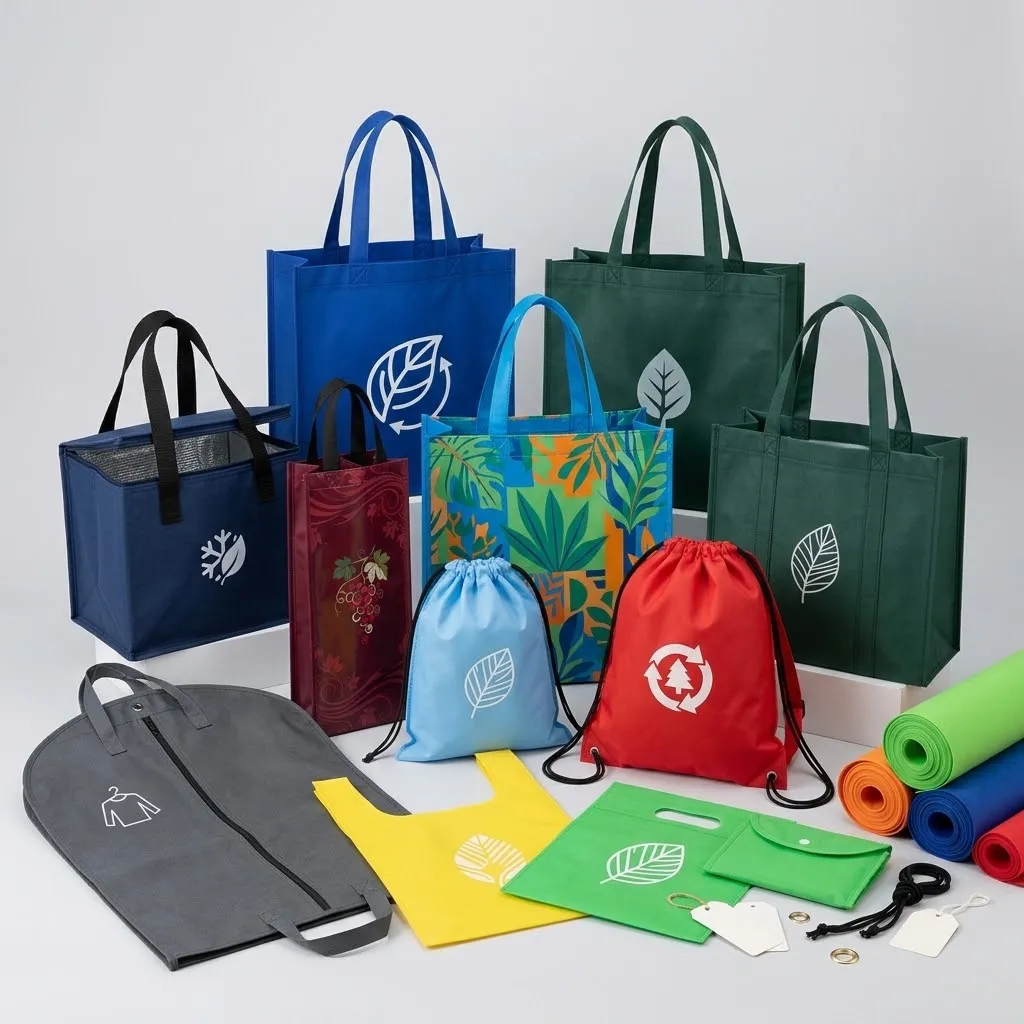
EcoLeaderPack manufactures custom non-woven bags across three primary polymer platforms, allowing procurement buyers to balance cost, tensile toughness, recycled content targets, and compostability credentials.
Virgin Polypropylene (PP Spunbond)
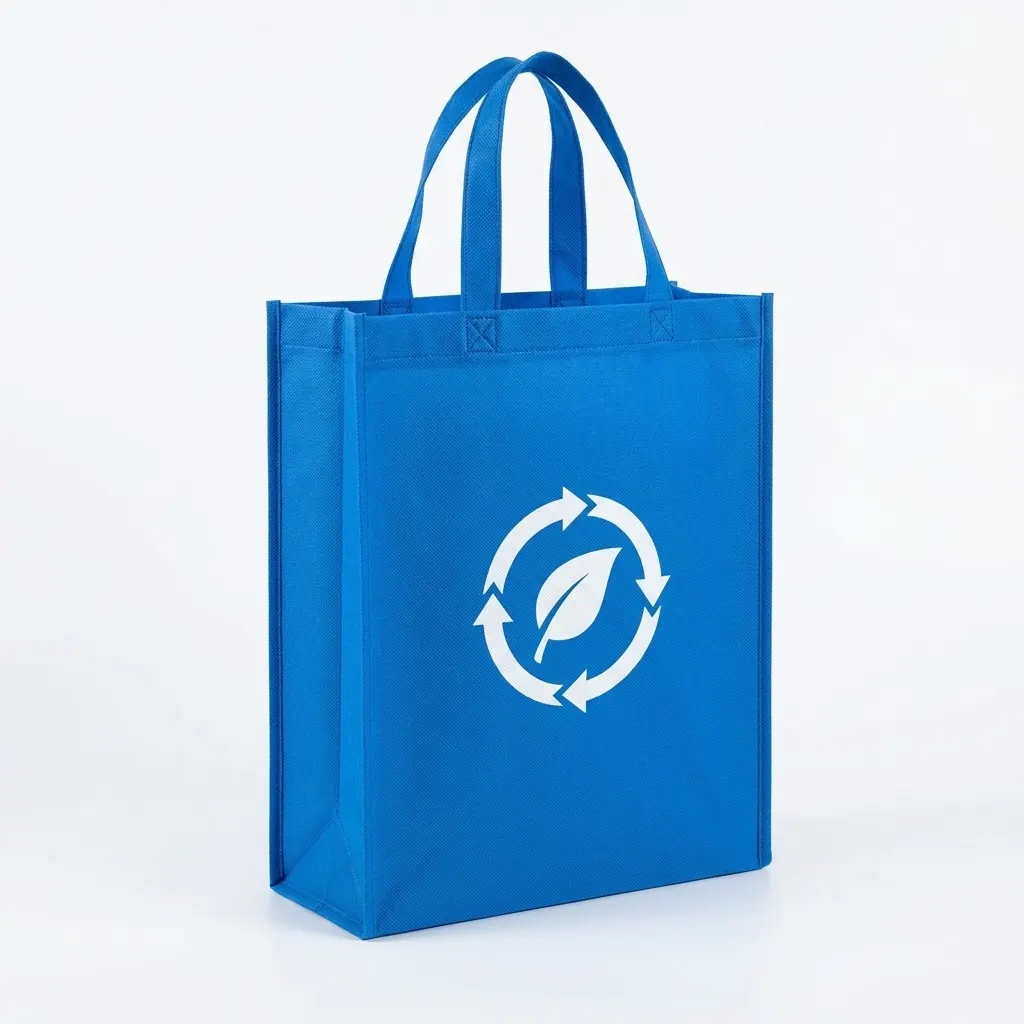
Polypropylene is the global volume standard for reusable commercial shopping totes. It provides the lowest unit manufacturing cost, superior resistance to acids, alkalis, and oils, virtually zero moisture absorption (<0.01%), and an extensive library of dope-dyed masterbatch colors. Virgin PP is fully recyclable through commercial polyolefin recycling streams (RIC #5), though municipal curbside collection remains limited in many regions. It does not biodegrade.
Recycled Polyethylene Terephthalate (RPET Spunbond)
RPET non-woven fabric is manufactured by mechanically shredding, washing, flaking, and re-extruding post-consumer PET bottles into high-tenacity filament webs. RPET provides a luxurious, soft textile finish that closely resembles cotton canvas, with superior abrasion resistance.
Regulatory Verification & Chain of Custody: Under the US FTC Green Guides (16 CFR §260.12), making an unqualified "recycled content" claim requires verified documentary proof that the feedstock originated from discarded post-consumer or post-industrial waste streams. EcoLeaderPack backs all RPET shipments with Textile Exchange Global Recycled Standard (GRS v4.0) certification:
- Scope Certificate (SC): Audits our spinning, weaving, and conversion facilities for environmental, chemical, and social criteria.
- Transaction Certificate (TC): Issued by an accredited third-party registrar (such as Control Union, SGS, or Intertek) verifying the exact shipment weight and certified percentage of post-consumer recycled content (minimum 20% for B2B documentation; minimum 50% for on-product consumer-facing GRS hangtags).
Polylactic Acid (PLA Spunbond)
PLA is a bio-based aliphatic polyester synthesized through the fermentation of agricultural plant starches (corn or cassava) into lactic acid, followed by ring-opening polymerization into PLA resin. PLA spunbond fabric provides a 100% bio-based alternative to fossil polyolefins, exhibiting natural bacteriostatic properties, low smoke emission upon combustion, and a smooth, silky hand feel.
Industrial Composting Boundaries: Sourcing managers must communicate claims accurately to avoid greenwashing liability. PLA does not break down quickly in domestic home compost piles, open soil, or cold marine environments. Complete biological breakdown requires the elevated temperatures (58°C ± 2°C) and controlled relative humidity found in industrial composting facilities compliant with European Standard BS EN 13432:2000 or US Standard ASTM D6400-23. Crucially, the entire bag assembly—including sewing threads, handle webbing, edge piping, and printing inks—must be certified compostable; sewing a PLA body with conventional polyester thread immediately voids composting compliance.
Swipe horizontally to compare engineering properties, unit cost indexes, and compliance criteria.
| Polymer Substrate | Feedstock Origin | Tensile Toughness (MD/CD) | Unit Cost Index | Legitimate Sustainability Claim | Key Procurement Watchpoints |
|---|---|---|---|---|---|
| Virgin Spunbond PP | Fossil petroleum | Moderate to High | 1.0 (Baseline) | "Reusable", "Durable repeat-use tote" | Classified as plastic under EU/US bag laws; non-biodegradable |
| GRS-Certified RPET | Post-consumer PET bottles | Very High (Canvas-like) | 1.45–1.65 | "Made with XX% Certified Recycled Plastic" | Requires lot-specific GRS Transaction Certificate (TC) |
| Biobased Spunbond PLA | Corn / Cassava starch | Moderate (Lower tear yield) | 2.20–2.60 | "Biobased", "Commercially Compostable" | Requires EN 13432 certification; thermal softening above 55°C |
Compare raw material specifications in our Packaging Materials Comparison Guide or explore customized solutions on our Custom Non-Woven Bags Collection page.
3. Fabric Weight (GSM), Caliper & Physical Strength
In non-woven manufacturing, GSM designates Grams per Square Meter (g/m²), measured according to ISO 9073-1:2023. Fabric weight directly governs fabric thickness (caliper), vertical tensile grab strength (ASTM D5034), puncture resistance, and final piece cost.
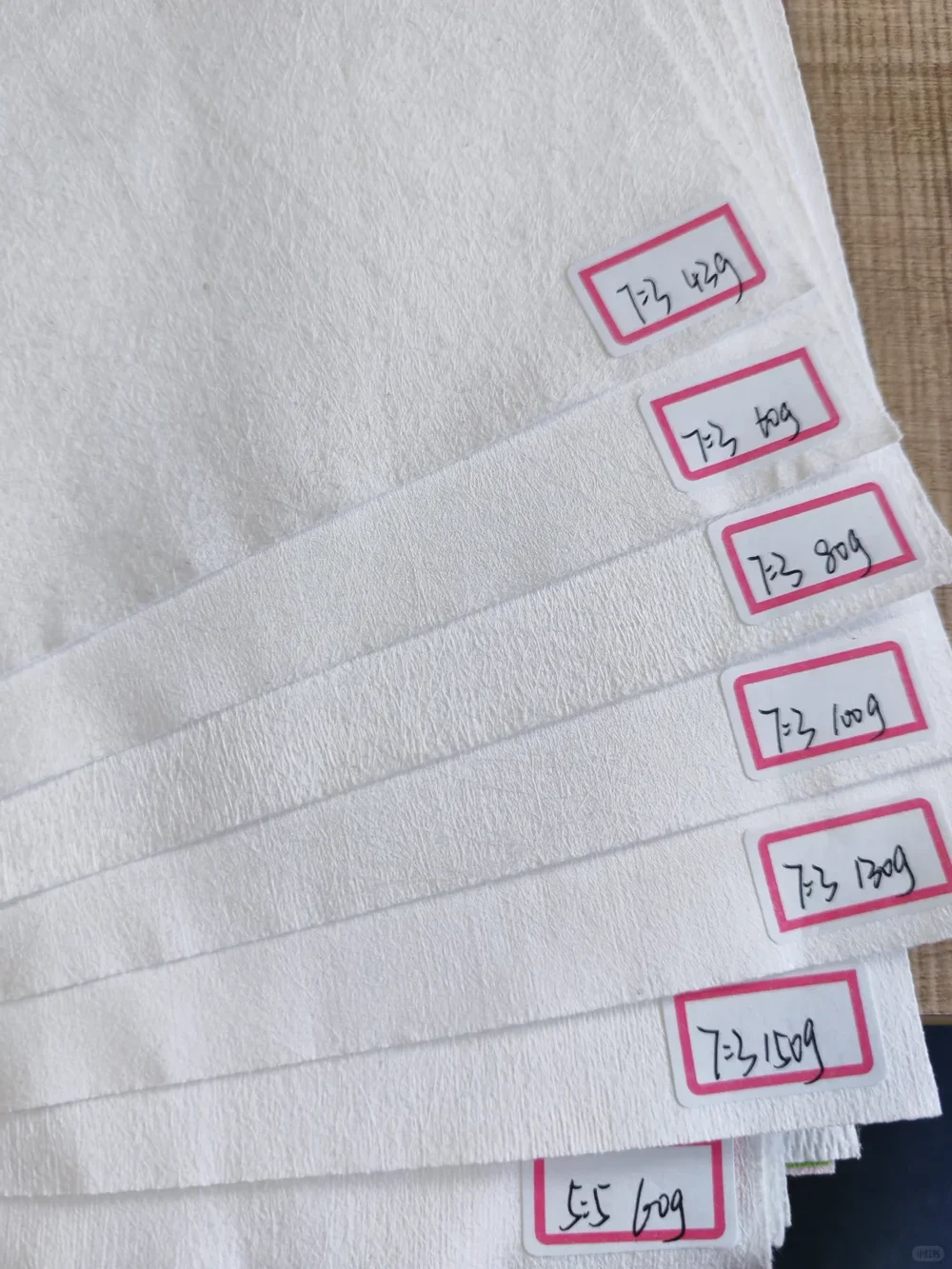
Across the industry, fabric weight aligns with practical application tiers:
- Lighter: one-event giveaways and document bags.
- Mid weights: everyday retail and promotional totes.
- Heavier: grocery loads, premium retail, bags meant to be kept for months.
Swipe horizontally to view caliper, mechanical strength, and recommended applications across all GSM tiers.
| GSM Tier | Caliper (Thickness) | Tensile Grab Strength (ASTM D5034) | Target Industry Applications | Recommended Assembly Method | Safe Working Load |
|---|---|---|---|---|---|
| 30–45 GSM | 0.16–0.22 mm | 45–70 N | Apparel dust covers, disposable medical pouches, laundry bags | Ultrasonic heat-sealing, drawstring | ≤1.5 kg |
| 50–65 GSM | 0.25–0.32 mm | 80–120 N | Trade-show literature bags, pharmacy carryout, shoe dust pouches | Ultrasonic D-cut or simple stitched loop | 2.0–4.0 kg |
| 70–85 GSM | 0.35–0.44 mm | 140–210 N | Core retail shopping totes, fast-casual takeout, bookstore bags | Ultrasonic box-bag or lockstitch with hem | 6.0–9.0 kg |
| 90–105 GSM | 0.46–0.54 mm | 230–310 N | Supermarket grocery bags, wine bottle carriers, corporate gifts | Industrial lockstitch, X-box handle root | 10.0–14.0 kg |
| 110–130 GSM | 0.56–0.66 mm | 330–440 N | Heavy-duty grocery box totes, insulated cooler outer shell | Reinforced lockstitch, base insert board | 15.0–20.0 kg |
| 140–150+ GSM | 0.70–0.80 mm | 460–580 N | Canvas-alternative totes, premium luggage bags, tool totes | Heavy continuous webbing, bar-tacked roots | 20.0–25.0+ kg |
Factory Grammage Tolerance & QA Verification: Commercial spunbond calenders operate at high continuous line speeds. Standard industrial production yields an allowable batch tolerance of ±4% to ±6%. Low-cost vendors often quote an "80 GSM" bag while extruding a 72–74 GSM substrate to shave 10% off raw material costs. When issuing purchase orders, explicitly state: "Fabric mass per unit area must be tested per ISO 9073-1, with batch mean ≥ stated GSM, tolerance not to exceed -3%."
Composite Grammage in Laminated Bags: When quoting laminated bags, always confirm whether the quoted GSM represents the base substrate alone or the composite finished weight. An 80 GSM non-woven fabric laminated with a 25 GSM printed BOPP film yields a composite finished weight of 105 GSM.
4. Construction Engineering: Sewn vs. Ultrasonic vs. Laminated
The manufacturing process used to assemble panels, gussets, and handles controls structural strength, cycle time, aesthetic refinement, and unit piece price. See full visual profiles on our Non-Woven Bag Styles guide.
Industrial Stitched (Sewn) Construction
In stitched bag assembly, cut panels, side gussets, bottom folds, and handles are assembled on industrial lockstitch sewing lines using continuous multi-filament polyester thread (typically 210D/3-ply or 250D/3-ply):
- Reinforced Cross-Box (X-Box) Stitching: The primary point of structural failure in any reusable tote is the handle-to-bag body junction. Simple single-line stitching pulls out under dynamic shock loads. Heavy-duty bags incorporate a 25×25 mm cross-box stitch pattern, which distributes vertical peel stress across the entire flange. In standardized laboratory pull tests, an X-box reinforced handle root withstands over 160 N of vertical tensile force before seam failure.
- Continuous Bottom-Wrap Webbing: For maximum carrying capacity (such as heavy grocery and supermarket totes), handle straps extend continuously down the front panel, run entirely underneath the bottom gusset, and rise up the rear panel. This transfers the entire payload weight directly to the high-tensile webbing strap rather than stressing the fabric seam.
- Seam Piping & Hem Binding: Raw interior seam edges are encased with a 20–25 mm folded non-woven binding ribbon, preventing fiber fraying and providing structural corner rigidity.
Ultrasonic Heat-Sealed Construction (D-Cut & W-Cut)
Ultrasonic assembly eliminates sewing thread, needles, and manual machine guidance. The machine focuses high-frequency acoustic vibrations (20 kHz to 40 kHz) through a shaped titanium horn (sonotrode) against a patterned rotary anvil. Millisecond acoustic friction melts the polypropylene molecular chains at the boundary layer, fusing the material as it cools under pressure.
- D-Cut Bags: Flat pouches with an oval die-cut handle punched near the upper lip. The most economical style for corporate events, retail packaging, and trade exhibitions.
- W-Cut (Vest / T-Shirt) Bags: Engineered with integrated side gussets and loop handles mirroring traditional single-use supermarket checkout bags. The side gussets open to provide generous packing volume, while the broad handle loops distribute hand pressure comfortably.
- Fully Automated Box Bags: Advanced automated ultrasonic bag-making machinery can convert rolled fabric into 3-dimensional box bags with bottom and side gussets at speeds exceeding 60–90 bags per minute, slashing labor costs by up to 60% compared to manual sewing.
- Strength Limitations: Ultrasonic weld seams exhibit lower peel resistance than stitched thread. For dynamic carrying loads exceeding 8–10 kg, stitched assembly remains the superior structural choice.
Laminated Non-Woven Bags (BOPP Film Lamination)
Lamination bonds a pre-printed polymeric film onto the spunbond non-woven fabric, creating a composite material with distinct functional advantages:
- Film Structure: Biaxially Oriented Polypropylene (BOPP) film, typically 18 to 25 microns thick, is reverse-printed using high-speed rotogravure printing presses. The film is then thermal-extrusion laminated to the non-woven base fabric using a molten polypropylene tie layer.
- Performance Benefits: Delivers 100% water barrier protection, smooth wipe-clean hygienic surface properties, and photorealistic full-color CMYK artwork reproduction with luxury matte or brilliant glossy finishes.
- Mono-Material Recyclability: Because both the base fabric (PP spunbond) and the laminated surface film (BOPP) share the identical polypropylene polyolefin polymer backbone, un-metallized laminated PP bags remain a mono-material polyolefin, preserving theoretical mechanical recyclability.
5. Commercial Printing & Surface Finishing Methods
Selecting the appropriate printing technology depends on graphic complexity, color count, order quantity, and unit budget:
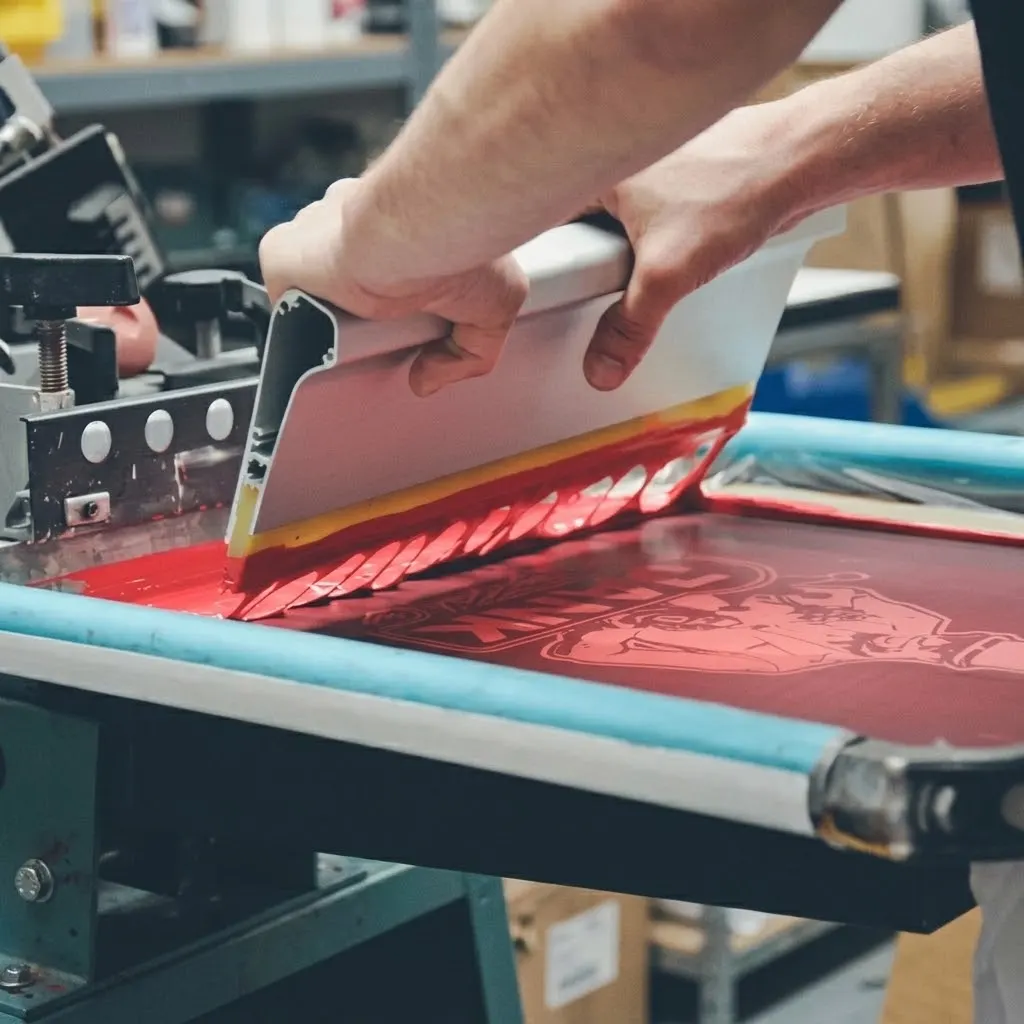
- Screen printing: ink is pushed through one screen per colour. Cost-effective for simple logos, and commonly offered in 1 to 4 spot colours. Each extra colour adds setup cost.
- Heat transfer: the design is printed on transfer film and pressed onto the bag. It is commonly used for full-colour detail and gradients on shorter runs. Test a sample for cracking under heavy use.
- Digital printing: full-colour artwork printed directly. Ask how colours hold on your chosen fabric colour.
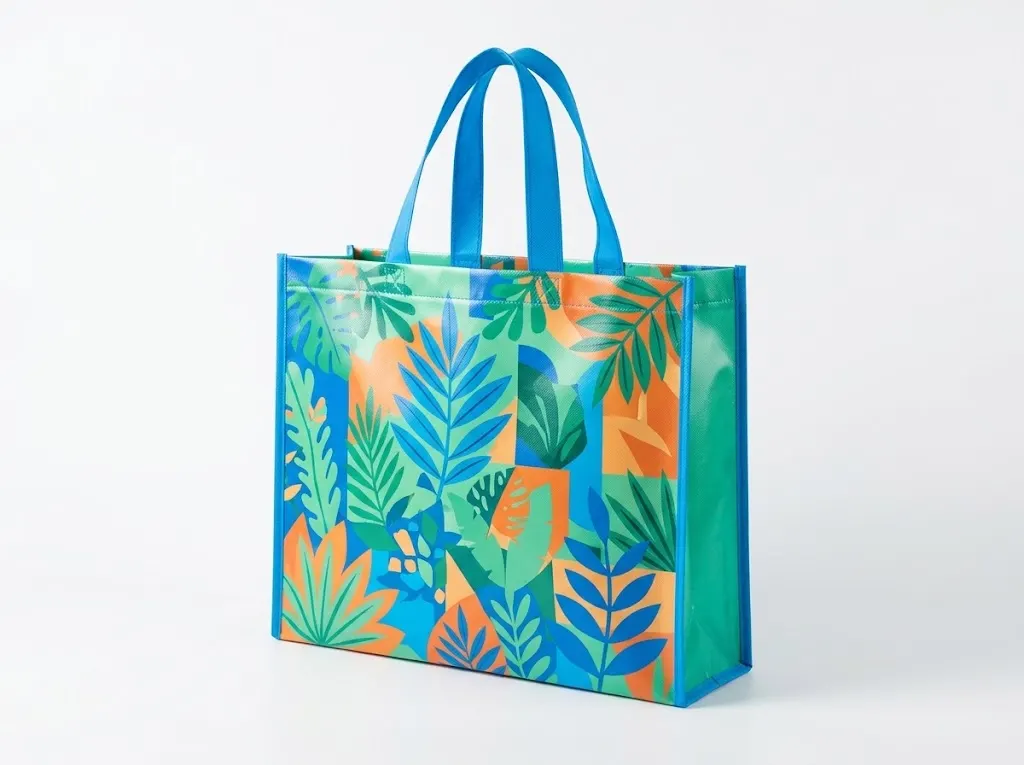
- Laminated printed film: the full design is printed on film, which is laminated onto the fabric. This gives the most photo-like result and is the hardest construction to recycle. The film is usually printed by gravure, which needs engraved cylinders, so many suppliers quote it from around 3,000 pieces per design.
Swipe horizontally to compare printing methods, color capabilities, setup tooling, and economic MOQs.
| Printing Technology | Optimal Graphic Type | Color Capability | Tooling / Setup Cost | Economic Run Size (MOQ) | Visual Finish & Texture |
|---|---|---|---|---|---|
| Silkscreen Printing | Bold vector logos, typography, simple corporate graphics | 1–4 spot colors (Pantone PMS matched) | Low ($15–$25 per screen) | 1,000 pcs | Matte, tactile ink deposit directly on fabric texture |
| Rotogravure BOPP Lamination | Full-color photographic imagery, gradients, complex retail artwork | CMYK + spot colors (up to 8 colors) | High ($80–$120 per steel cylinder) | 3,000–5,000 pcs | Continuous glossy or soft-touch matte protective film |
| Heat Transfer Sublimation | Multi-color graphics with fine detail on short runs | Full-color photographic | Moderate ($30–$50 setup) | 1,000 pcs | Thin vinyl/polymer film patch heat-pressed to panel |
| Flexographic Printing | Continuous repeating patterns, basic packaging text | 1–2 simple colors | Moderate (photopolymer plates) | 10,000+ pcs | Fast in-line application; lower ink density than screen |
For custom branding programs, EcoLeaderPack provides digital die-line proofs within 24 hours. Learn more about our private-label printing capabilities under Custom Packaging Solutions.
6. Industry Application Scenarios & Specification Blueprints
To assist procurement managers in drafting accurate purchase orders, EcoLeaderPack engineers specialized non-woven bag configurations tailored to specific commercial use cases:
1. Supermarket Heavy-Duty Grocery Box Tote
Primary Function: High-payload grocery checkout, carrying canned goods, dairy cartons, glass jars, and heavy pantry staples.
Recommended Spec: 100–120 GSM virgin PP spunbond; 38 cm (W) × 42 cm (H) × 16 cm (BG/SG); full-wrap PP webbing handles (3.8 cm wide) running under base; removable 1.2 mm rigid PP bottom board to prevent sag; reinforced X-box stitching.
Payload Rating: 15.0–18.0 kg dynamic load (≥125 reusable cycles).
Explore matched solutions: Supermarkets and Ready Meals Packaging and Takeaway and Delivery Packaging.
2. Anti-Tilt Restaurant Takeaway Carrier Bag
Primary Function: Food delivery courier transport, holding round paper soup bowls, bento meal boxes, and beverage cups flat without tipping.
Recommended Spec: 75–85 GSM spunbond PP; wide square base (28×28×20 cm or 32×30×22 cm); ultrasonic heat-sealed box bag with reinforced die-cut handles or broad loop handles; grease-repellent surface.
Payload Rating: 6.0–8.0 kg static load.
Explore matched solutions: Restaurants and Cafes Packaging, Custom Kraft Paper Bags, and Kraft Paper Carrier Bags.
3. Thermal Insulated Cooler Grocery Tote
Primary Function: Cold-chain delivery, transporting frozen meals, ice cream, fresh meats, and chilled dairy while preventing temperature rise.
Recommended Spec: Triple-layer composite: 80 GSM non-woven outer + 2.5 mm closed-cell EPE thermal foam core + reflective food-grade aluminum foil lining; heavy-duty nylon zipper top closure; reinforced webbing shoulder strap.
Thermal Performance: Maintains cold temperature (2°C–8°C) for 3–5 hours with ice packs.
Explore matched solutions: Takeaway & Delivery Packaging Solutions.
4. Luxury Matte Laminated Boutique Shopping Bag
Primary Function: High-end fashion boutiques, cosmetics, luxury department stores, and branded jewelry retail merchandising.
Recommended Spec: 90 GSM spunbond PP laminated with 20 µm soft-touch matte BOPP film; rotogravure 4-color process + metallic foil hot stamping; woven grosgrain ribbon or padded tubular handles; magnetic or snap button closure.
Payload Rating: 8.0–10.0 kg.
Explore matched solutions: Non-Woven Bag Styles and Custom Packaging & Private Label.
5. Multi-Bottle Divided Wine & Spirits Tote
Primary Function: Winery retail shops, craft breweries, and liquor stores carrying 750 mL glass bottles securely.
Recommended Spec: 110–120 GSM heavy-duty non-woven; 18 cm (W) × 35 cm (H) × 10 cm (D) for 2 bottles (or 27×35×18 cm for 6 bottles); internal padded collapsible non-woven divider sleeves; 3.0 cm wide reinforced webbing handles.
Payload Rating: 8.0–12.0 kg with complete glass clink protection.
Explore matched solutions: Custom Non-Woven Bags and Catering and Events Packaging.
6. Trade Show & Convention Literature Bag
Primary Function: Fast, economical distribution of exhibition catalogs, A4 corporate brochures, sample kits, and promotional merchandise.
Recommended Spec: 60–70 GSM spunbond PP; 35 cm (W) × 40 cm (H) flat pouch or 32×38×8 cm gusseted tote; ultrasonic welded D-cut handle or spot-welded loop handle; 1- or 2-color silkscreen logo print.
Payload Rating: 3.0–5.0 kg.
Explore matched solutions: Catering and Events Packaging and Distributors and Private Label Solutions.
7. Breathable Garment Suit Cover & Dry Cleaning Bag
Primary Function: Protecting tailored suits, evening gowns, jackets, and luxury coats from dust and moths while allowing fabric to breathe.
Recommended Spec: 65–80 GSM breathable virgin PP; 60 cm (W) × 100 cm (H) (suits) or 60×130 cm (coats); full-length center #5 nylon zipper; reinforced top hanger slot; clear oval PE view window.
Features: Dust-proof, mold-resistant, moth-repellent, highly breathable.
Explore matched solutions: Custom Packaging Solutions.
8. Pharmacy & Medical Carryout Bag
Primary Function: Clean, moisture-resistant packaging for pharmaceutical dispensaries, medical clinics, and wellness retailers.
Recommended Spec: 50–65 GSM virgin PP; ultrasonic W-cut vest bag (26×45×12 cm) or D-cut pouch; clean white or hospital green dope-dyed substrate; optional tamper-evident peel-and-seal adhesive strip.
Payload Rating: 2.5–4.5 kg.
Explore matched solutions: Custom Non-Woven Bags Collection.
7. Sizing Formulas, Handle Ergonomics & Load Benchmarks
Commercial tote bag dimensions are specified as Width × Height × Gusset (Bottom Gusset or Side Gusset):
Swipe horizontally to view standard dimensions, internal volumes, and handle specifications.
| Size Tier | Dimensions (W × H × Gusset) | Usable Volume (Liters) | Handle Specification | Recommended Payload | Typical Use Case |
|---|---|---|---|---|---|
| Mini / Boutique | 22 × 26 × 8 cm | 4.5 L | 2.5 × 32 cm self-fabric, ultrasonic | 2.0–3.0 kg | Jewelry, watches, sunglasses, cosmetics |
| Small Retail | 28 × 35 × 10 cm | 9.8 L | 2.5 × 38 cm self-fabric loop, sewn | 4.0–6.0 kg | Books, small apparel, pharmacy items |
| Standard Retail (A4) | 35 × 40 × 12 cm | 16.8 L | 2.5 × 48 cm self-fabric or PP webbing | 7.0–10.0 kg | Clothing retail, catalogs, shoe boxes |
| Large Supermarket | 42 × 38 × 16 cm | 25.5 L | 3.0 × 55 cm heavy webbing, X-box | 12.0–16.0 kg | Full grocery cart load, supermarket checkout |
| Takeaway Anti-Tilt | 30 × 30 × 22 cm | 19.8 L | 3.0 × 40 cm broad handle, box-bag | 6.0–8.0 kg | Food delivery bento boxes, soup tubs |
| 2-Bottle Wine Tote | 18 × 35 × 10 cm | 6.3 L | 3.0 × 42 cm heavy webbing with divider | 8.0–10.0 kg | Wineries, liquor stores, corporate wine gifts |
Handle Ergonomics: Drop Height & Carrying Modes
Specifying handle strap dimensions controls how consumers interact with the bag:
- Hand-Carry Handle: Total strap length 35 cm to 42 cm (resulting in a vertical drop height of 12 cm to 16 cm). Optimizes carrying efficiency for short walking trips, preventing bag bottoms from brushing against the floor.
- Shoulder-Carry Handle: Total strap length 58 cm to 68 cm (resulting in a vertical drop height of 28 cm to 32 cm). Allows shoppers to carry heavy grocery and market loads hands-free over their shoulder.
- Handle Width: Standard widths are 2.5 cm for light totes and 3.0 cm to 3.8 cm for heavy supermarket bags. Broader webbing distributes pressure across the shoulder, preventing strap cut-in during heavy transit.
The 125-Use Statutory Durability Benchmark
To verify that a non-woven bag satisfies statutory "reusable" mandates rather than functioning as single-use plastic, the international benchmark is set by New York State's 6 NYCRR Part 351 (Bag Waste Reduction Act). Under this standard, a reusable bag must survive:
- A minimum lifespan of 125 individual uses.
- Each use requiring the bag to carry a minimum payload of 22 pounds (9.98 kg) over a minimum walking distance of 175 feet (53.3 meters) without handle tear or seam separation.
To satisfy this statutory benchmark, EcoLeaderPack engineers non-woven bags with a minimum fabric weight of 85–90 GSM with cross-box handle reinforcement, or 100 GSM for ultrasonic welded box bags.
8. Environmental LCA Data & Legal Marketing Claims
Non-woven bags achieve a lower net environmental footprint than single-use carrier bags only after achieving a specific break-even threshold of repeated consumer reuse. Three public life-cycle studies put numbers on that:
- UK Environment Agency (2011): a non-woven PP bag should be reused at least 11 times to have lower global warming potential than a conventional HDPE carrier bag that is not reused. If 40.3% of HDPE bags are reused as bin liners, the figure becomes 14.7 It covered UK bags from 2006 and found the PP bag significantly worse on terrestrial ecotoxicity.
- Danish Environmental Protection Agency (2018): non-woven PP bags should be reused at least 6 times for climate change and at least 52 times when all environmental indicators are considered.8
- UNEP (2020): a meta-analysis of seven life-cycle studies estimates that a durable PP bag must be used 10-20 times to match one single-use plastic bag on climate. The same report cites a US study that found non-woven PP bags were reused 14.6 times on average.9
Swipe horizontally to compare peer-reviewed LCA reuse break-even points.
| Authoritative LCA Study | Testing Methodology & Scope | Break-Even Reuses (Climate Change GWP Only) | Break-Even Reuses (All Environmental Indicators Combined) |
|---|---|---|---|
| UK Environment Agency (Report SC030148) | Cradle-to-grave analysis evaluating global warming potential, resource extraction, and acidification. | 11 reuses (rises to 14 reuses if 40.3% of single-use HDPE bags are reused as household bin liners) | Significantly higher when including terrestrial ecotoxicity from PP polymer extraction. |
| Danish EPA (Environmental Project no. 1985) | Holistic LCA evaluating 15 environmental indicators including ozone depletion, photochemical ozone, and water use. | 6 reuses | 52 reuses (driven by upstream energy consumption and fiber extrusion). |
| UNEP / Life Cycle Initiative (2020) | Meta-analysis synthesizing seven independent global LCA studies across Europe, North America, and Asia. | 10 to 20 reuses | Average empirical consumer reuse documented in US studies was 14.6 times, passing the climate break-even point. |
Legal Compliance for Marketing & Print Claims
Regulatory authorities actively penalize unsubstantiated sustainability marketing:
- Avoid unqualified “eco-friendly”, “green” or “environmentally friendly”. The FTC Green Guides advise against unqualified general environmental benefit claims.10 In the EU, Directive (EU) 2024/825 bans generic environmental claims made without recognised excellent environmental performance, applied by Member States from 27 September 2026.
- “Recyclable” needs qualifying. An unqualified claim needs recycling facilities available to a substantial majority (60 percent) of consumers or communities where the item is sold. Otherwise qualify it, for example “recyclable where PP collection exists”.
- Never call PP bags “biodegradable”. An unqualified degradable claim needs evidence that the whole item completely breaks down within a reasonably short time after customary disposal, which rules out items that usually end up in landfill, incineration or recycling.
- Self-declared claims have an international standard. ISO 14021:2026 covers self-declared claims such as “recyclable” and “recycled content”.
- Safe wording: “reusable”, “designed for repeated use”, “made with recycled PET” (only with a certificate, and with the actual percentage stated), “please reuse this bag”.
9. International Market Compliance: EU PPWR, US & Australia
Before importing custom non-woven bags, confirm destination compliance rules:
European Union: PPWR (Regulation (EU) 2025/40) & Directive (EU) 2015/720
Historically, Directive (EU) 2015/720 restricted lightweight plastic carrier bags under 50 microns. Under the comprehensive Packaging and Packaging Waste Regulation (EU) 2025/40 (PPWR), Article 34 maintains consumption reduction mandates and empowers Member States to impose modulated EPR fees or economic levies on plastic shopping bags regardless of thickness. For deeper compliance planning, read our PPWR 2026 Food Packaging Buyer's Preparation Guide.
United States: California (Senate Bill 1053)
California enacted Senate Bill 1053 (SB 1053), effective January 1, 2026. SB 1053 closed the loophole under older SB 270 legislation that permitted retailers to hand out thick plastic film bags. Under SB 1053, covered grocery stores, pharmacies, and retail establishments are strictly prohibited from providing any plastic carryout bag at the point of sale. Checkout bags must be 100% recycled paper bags (charged at ≥$0.10). Consequently, non-woven bags cannot be distributed as point-of-sale checkout bags in covered retail stores; they may only be sold as merchandise or provided at corporate promotions and non-covered venues.
United States: New York (Bag Waste Reduction Act)
Under New York State 6 NYCRR Part 351, a compliant "reusable bag" provided by covered commercial retail stores must be made of non-plastic fabric (such as cotton, hemp, or linen). The New York Department of Environmental Conservation explicitly lists non-woven polypropylene, laminated PP, and RPET as plastic materials, excluding them from checkout distribution in covered stores.
Chemical Safety: EU REACH & California Proposition 65
Under Article 33 of the EU REACH Regulation (EC No 1907/2006), importers must declare any Substances of Very High Concern (SVHC) present above 0.1% by weight. For US distribution, products must meet California Proposition 65 limits for total lead content (<100 ppm) and phthalates (<1,000 ppm). EcoLeaderPack supplies lot-specific SGS/Intertek test dossiers on request. Review our testing standards on our Quality Inspection & Compliance page.
10. Manufacturing Cost Levers, MOQs & Production Workflow
Eight direct operational levers govern the landed piece cost of custom non-woven bags:
- Fabric Weight (GSM): Shifting from 80 GSM down to 70 GSM reduces raw resin consumption by 12.5%. Conversely, moving up to 110 GSM for heavy supermarket bags increases base fabric costs proportionally.
- Base Polymer Selection: Virgin PP is the most economical baseline (1.0). Certified RPET carries an index of ~1.45–1.65, while PLA bio-resin carries an index of ~2.20–2.60.
- Assembly Automation: Ultrasonic machine-welded box bags reduce direct conversion labor by 50% to 70% compared to hand-guided lockstitch sewing with seam edge binding.
- Printing Technology: Silkscreen requires low setup fees ($15–$25 per screen) for 1–3 spot colors. Rotogravure BOPP lamination requires initial cylinder engraving ($80–$120 per color cylinder), amortized over runs of 5,000+ units.
- Hardware Add-Ons: Metal eyelets, snap buttons, zipper closures, Velcro tabs, or rigid bottom insert boards add $0.05 to $0.25 per unit in material and manual labor.
- Order Volume & MOQs: EcoLeaderPack maintains a flexible production MOQ of 1,000 pieces for standard stock fabric colors. Custom Pantone-dyed fabric batches require an extruder purge run, setting the raw fabric minimum at ~500 kg (equivalent to roughly 6,000 to 12,000 finished bags).
- Carton Logistics & Freight Density: Standard bulk packing (150–250 bags per master carton) maximizes container cube. Individual retail polybagging, hangtags, or barcode stickers add manual packing steps.
- Incoterms & Shipping: Quoting FOB Ningbo/Shenzhen vs. CIF or DDP (Delivered Duty Paid) directly to your distribution center warehouse.
Standard Commercial Production Workflow
EcoLeaderPack manages a 5-stage production timeline:
- Day 1–2: Specification & Vector Proofing: Confirm bag dimensions, handle drop specs, and vector artwork (AI/EPS/PDF). Reconcile Pantone PMS color codes.
- Day 3–4: Tooling & Plate Preparation: Prepare silkscreen meshes or engrave high-precision rotogravure steel cylinders.
- Day 5–8: Physical Pre-Production Sample: Fabricate physical sample bags for visual inspection, handle tensile verification, and color approval. Samples air-shipped for sign-off.
- Day 9–18: Mass Extrusion, Printing & Assembly: Precision fabric extrusion, rotary printing, sewing/ultrasonic assembly, and QA inspection according to ISO 2859-1 (AQL 2.5 Major / 4.0 Minor).
- Export Shipping: Packed into 5-ply corrugated export cartons (ECT-44), shrink-wrapped on 1,200 × 1,000 mm ISO pallets, and dispatched via sea freight (20GP holding ~40,000 bags; 40HQ holding ~95,000 bags).
11. Strategic Sourcing: Reusable Non-Woven vs. Kraft Paper Bags
Enterprise retail and foodservice procurement programs achieve maximum efficiency by deploying both non-woven and paper formats across consumer touchpoints:
Custom Kraft Paper Bags
Manufactured from 100% recyclable virgin or recycled kraft paper with twisted or flat handles. The mandatory choice for single-trip retail, bakery, and food delivery where municipal curbside paper recycling or local bag bans (e.g. California SB 1053) require paper carryout solutions.
Explore Custom Kraft Paper Bags →
Explore Kraft Paper Carrier Bags →
Custom Non-Woven Totes
Durable, water-resistant spunbond polypropylene and RPET bags engineered for multi-month consumer reuse, high-load grocery shopping, trade show literature carrying, and sustained brand visibility.
Explore Custom Non-Woven Bags →
Explore Custom Packaging Solutions →
Brands frequently consolidate procurement by ordering reusable non-woven totes alongside kraft paper carrier bags, branded custom tissue boxes, and custom printed paper napkins to minimize vendor overhead. Discover integrated programs under our Distributors and Private Label Packaging Solutions.
12. Technical RFQ Specification Blueprint
Paste this checklist into your request so every supplier quotes the same bag:
- Use and destination market (country, and state for the US)
- Bag style (stitched tote, D-cut, W-cut, drawstring, foldable, other)
- Size: width × height × gusset
- Material: PP, RPET (state the recycled content required) or PLA (state the certificate required)
- Fabric GSM and tolerance; lamination wanted or not (gloss or matte, film thickness)
- Handle type and length; reinforcement; add-ons
- Print method, number of colours, Pantone references, print area per side
- Quantity, plus any split by colour or design
- Load requirement and test method, if any
- Documents needed: test reports, recycled-content or compostability certificates
- Packing (pieces per carton) and Incoterm with named port
- Target delivery date
13. Explore More (Upcoming Articles & Guides)
These specialized guides and procurement topic deep-dives are in preparation:
- Non-Woven Bag GSM Guide: How to Choose the Right Fabric Weight
- Non-Woven Bag Printing Methods Compared
- Laminated vs Non-Laminated Non-Woven Bags
- D-Cut vs W-Cut vs Loop-Handle Non-Woven Bags
- Sewn vs Ultrasonic (Heat-Sealed) Non-Woven Bags
- Non-Woven Bag Size Guide
- How Much Weight Can a Non-Woven Bag Hold?
- Paper Bags vs Non-Woven Bags for Retail and Takeaway
- Are Non-Woven Bags Eco-Friendly? An Evidence-Based Answer
- Plastic Bag Rules for Importers: EU, UK, US States and Australia
- RPET vs PP vs PLA Non-Woven Bags
- What Affects the Price of Custom Non-Woven Bags?
- How to Order Custom Non-Woven Bags from a China Factory
- Custom Non-Woven Wine Bags
- Branded Packaging for Restaurants, Cafés and Hotels
14. Frequently Asked Questions
What is a non-woven bag made of?
Mostly polypropylene (PP) fibres bonded with heat. Alternatives are recycled PET (RPET) and plant-based PLA.
Is a non-woven bag plastic?
Yes. Standard non-woven bags are polypropylene, a plastic. New York’s environmental agency lists non-woven polypropylene as a plastic material.
What is the standard minimum order quantity (MOQ) for custom non-woven bags?
EcoLeaderPack maintains an MOQ of 1,000 pieces for standard stock fabric colors with spot silkscreen or heat transfer printing. For custom Pantone-dyed fabric batches or full-color rotogravure BOPP laminated bags, the MOQ is 3,000 to 5,000 pieces to amortize extrusion setup and cylinder engraving costs.
Can non-woven bags be distributed at retail checkout in California?
No. Under California Senate Bill 1053 (effective January 1, 2026), grocery stores, retail pharmacies, and convenience stores may only provide recycled paper carryout bags at checkout. Non-woven bags cannot be distributed as point-of-sale checkout bags in covered retail stores; they may only be sold as retail merchandise or used in non-covered promotional venues.
What is the difference between D-cut and loop-handle non-woven bags?
A D-cut bag features an oval handle punched directly into the upper fabric panel, making it a flat, economical choice for event giveaways and document carrying. A loop-handle bag features separate flexible fabric or webbing straps attached to the top rim, providing superior comfort, greater carrying capacity, and shoulder-carry ergonomics.
Are non-woven polypropylene bags recyclable?
Chemically, yes: PP non-woven is 100% polypropylene (Resin Identification Code 5). However, because spunbond fabric cannot be processed in municipal curbside sorting MRFs, recycling claims must be qualified: "Recyclable in commercial collection drop-off programs that accept polypropylene films."
How many times must a non-woven PP bag be reused to match a single-use bag?
According to the UK Environment Agency (Report SC030148), a non-woven PP bag must be reused at least 11 times to achieve lower global warming potential than a conventional single-use HDPE carrier bag. The Danish EPA estimates a break-even of 6 reuses for climate change and 52 reuses when considering all environmental categories.
Request Custom Non-Woven Bag Samples or a Bulk Quotation
EcoLeaderPack manufactures custom non-woven shopping totes, laminated retail bags, insulated cooler carriers, and garment covers for retail brands, supermarket chains, and corporate distributors worldwide. We provide fast digital proofs, physical pre-production samples, GRS chain-of-custody certificates, and comprehensive export logistics.
Send Your Non-Woven Bag Specifications
Share your target dimensions, fabric GSM, bag style, handle preference, printing artwork, annual volume, and destination port. EcoLeaderPack will review your requirements and provide a competitive factory quotation.