Use US fl oz for most US cup specifications
Multiply by 29.5735295625. A 10 US fl oz cup is 295.735 mL, usually described commercially as about 300 mL.
Cup capacity, without the unit guesswork
Enter the fluid-ounce size on a cup, bottle, or filling sheet and see the milliliter equivalent. Choose US or Imperial fl oz first—the two systems are close, but not identical.
1 US fl oz is 29.5735 mL. 1 Imperial fl oz is 28.4131 mL. For a 10 fl oz cup, that difference is about 11.6 mL.
Select the measurement system printed on the specification, then enter the fluid ounces.
Milliliter result
295.7353 mL
Formula used
mL = US fl oz × 29.5735295625
Use both columns when a supplier sheet says fl oz but does not state whether the unit is US or Imperial.
| fl oz | US fl oz → mL | Imperial fl oz → mL |
|---|---|---|
| 1 fl oz | 29.57 mL | 28.41 mL |
| 2 fl oz | 59.15 mL | 56.83 mL |
| 4 fl oz | 118.29 mL | 113.65 mL |
| 6 fl oz | 177.44 mL | 170.48 mL |
| 8 fl oz | 236.59 mL | 227.3 mL |
| 10 fl oz | 295.74 mL | 284.13 mL |
| 12 fl oz | 354.88 mL | 340.96 mL |
| 16 fl oz | 473.18 mL | 454.61 mL |
| 20 fl oz | 591.47 mL | 568.26 mL |
| 32 fl oz | 946.35 mL | 909.22 mL |
Cup names are nominal capacities. Rim-full capacity, recommended serving volume, lid clearance, ice, foam, and ingredients can all reduce the usable fill.
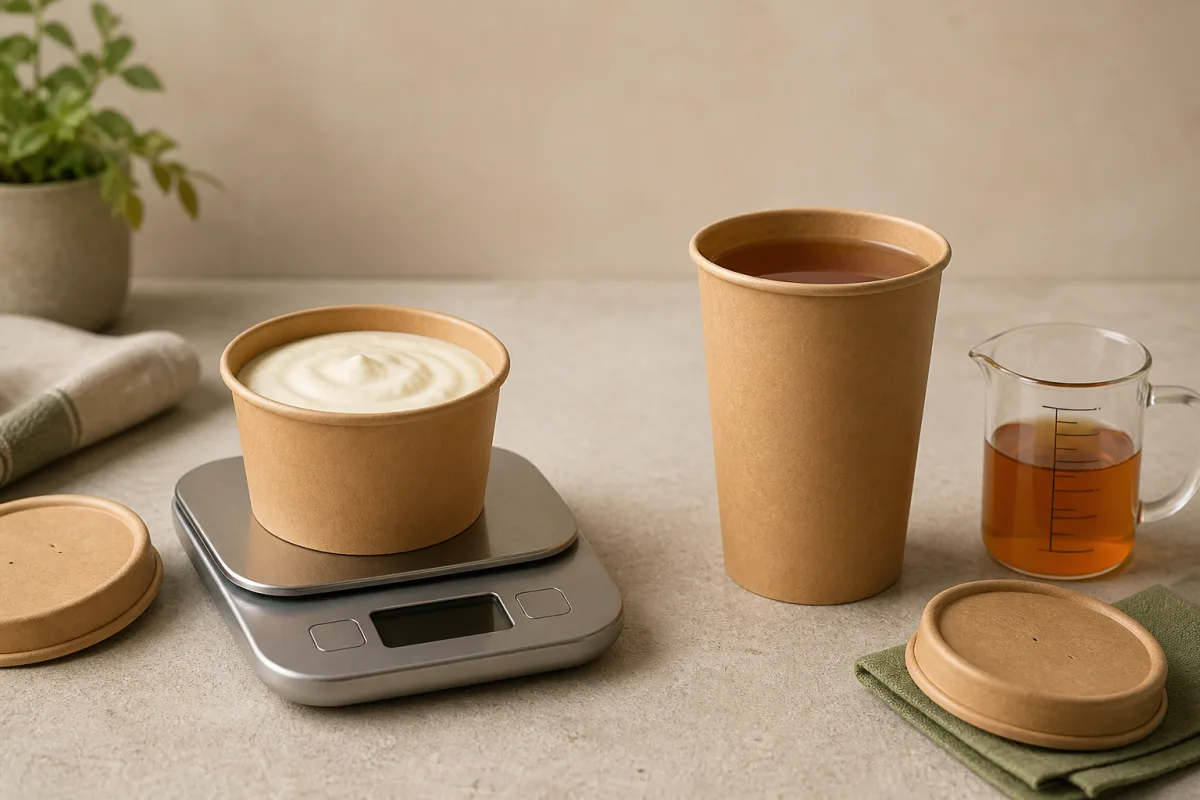
= 283.5 g
= 295.7 mL
One small label check
Milliliters and fluid ounces both measure volume, so they convert directly. A plain oz used for net weight measures mass and needs product density before it can become a volume.
Packaging catalogs often shorten a fluid-ounce capacity to “oz.” A food label or recipe may use the same letters for weight. Check the capacity field, drawing, or test report before choosing the formula.
The right factor comes from the market and the source specification, not from the cup material.
Multiply by 29.5735295625. A 10 US fl oz cup is 295.735 mL, usually described commercially as about 300 mL.
Multiply by 28.4130625. A 10 Imperial fl oz measure is 284.131 mL.
Leave room for the lid, movement, ice, foam, toppings, or expansion. A nominal 300 mL cup is not always meant to be filled with 300 mL of product.
Confirm that the source unit is fluid ounces and identify US or Imperial.
Enter the fl oz value and keep enough decimal precision for the job at hand.
Compare the result with the cup drawing and run a real fill test with the intended lid and headspace.
If oz means a US fluid ounce, 1 fl oz equals 29.5735295625 mL. One Imperial fl oz equals 28.4130625 mL.
10 US fl oz equals 295.735 mL. 10 Imperial fl oz equals 284.131 mL. Confirm the system before ordering a cup.
No. The Imperial fluid ounce is about 3.9% smaller than the US fluid ounce.
No. Weight oz measures mass, while mL measures volume. You need the product density to convert between them.
Tell us what the food is, how much goes in, whether it is served hot or cold, and where it will be sold. We can narrow the packaging options before you spend time on samples.