Buyer summary: Before ordering sugarcane bagasse tableware, check seven categories of evidence: food-contact suitability, compostability claims, PFAS testing, factory controls, restricted substances, performance and labeling. They are not a universal set of seven legally mandatory certificates. The required evidence depends on the finished product, its intended use, destination market, claims and your purchasing specification.
Bagasse is the fiber left after sugarcane processing. A molded bagasse container may also contain additives, a coating, printing or a separately supplied lid. The name of the main material alone does not establish the safety, compostability or heat tolerance of the complete item.
This checklist helps buyers identify questions and gaps in a supplier file. It separates legal compliance evidence from commercial requirements and voluntary certification, so a quotation can be assessed against the product actually being supplied.
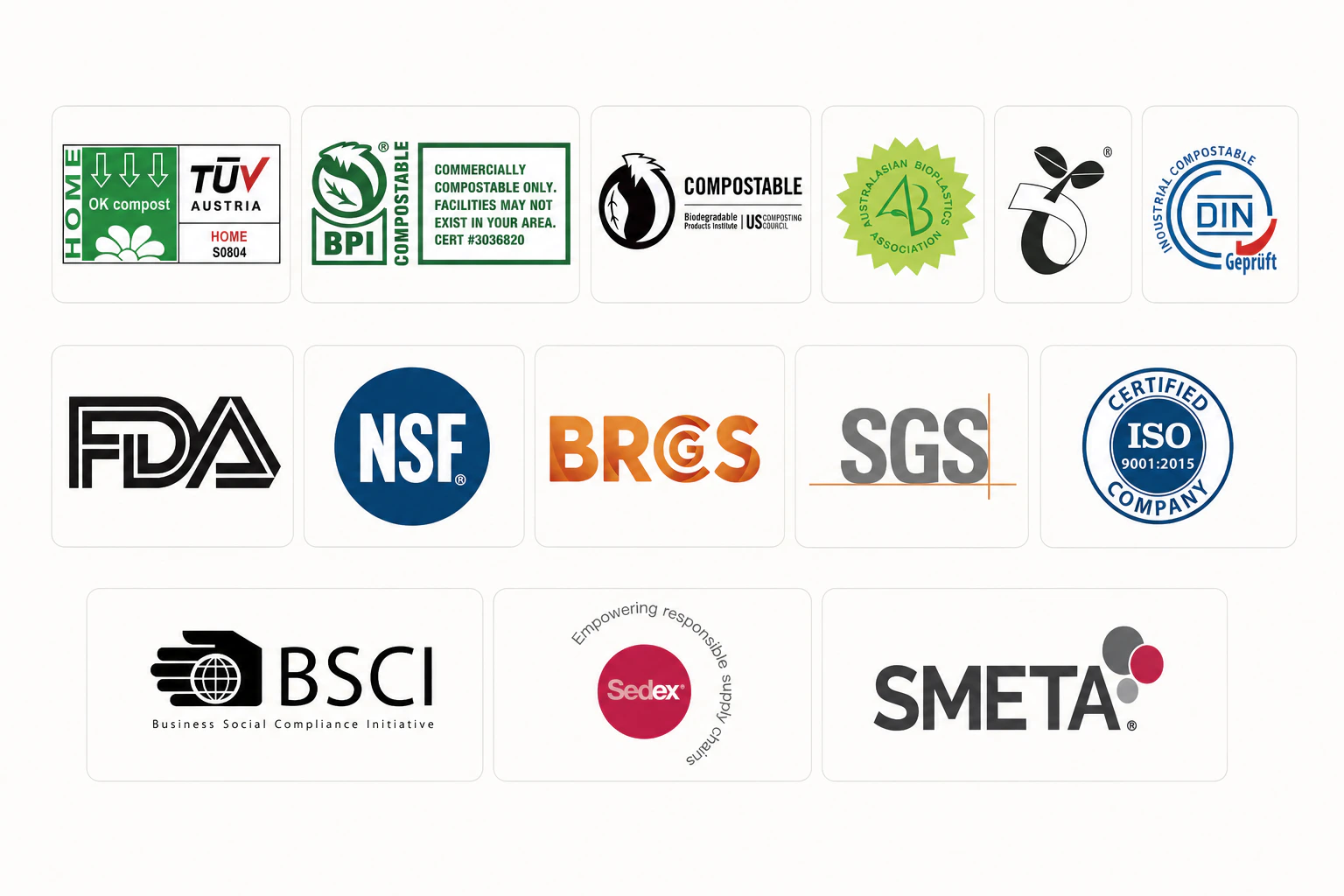
Seven document categories to review before ordering
| Evidence category | Why request it? | What to match to your order |
|---|---|---|
| 1. Food-contact documentation | Evidence supporting applicable legal requirements | Composition, food type, contact time, temperature and intended market |
| 2. Compostability evidence | Supports a specific claim or certification mark; certification may also be a buyer requirement | Finished-product coverage, home or industrial conditions, valid license and local collection route |
| 3. PFAS and fluorine information | Relevant legal, buyer or certification requirements | Named substances, analytical method, units, reporting limits and formulation declaration |
| 4. Manufacturing controls | Applicable production obligations and buyer audit requirements | Actual factory, processes, audit scope and certificate validity where certification is requested |
| 5. Restricted-substance assessment | Evidence for the rules applying to the materials and destination | Fiber, additives, inks, coatings and lids; relevant tests and supplier declarations |
| 6. Physical performance data | Commercial acceptance and support for use claims | Menu, filling temperature, holding time, reheating, lid fit and transport conditions |
| 7. Label and claim review | Accuracy of consumer information and any use of certification marks | Exact wording, language, disposal instructions, evidence and local rules |
Match food-contact evidence to the intended use
For US orders, FDA explains that a food-contact material's regulatory status depends on its components and the relevant authorizations, specifications and use limitations. A supplier letter of guaranty can be part of the supporting file. An FDA-related test report is not a universal FDA product approval certificate.
For EU orders, review the applicable food-contact framework, good manufacturing practice requirements and any material-specific or national requirements with the supplier or a qualified laboratory. Do not assume that one plastic-material test covers uncoated fiber, or that a fiber report covers a separately supplied plastic lid.
Ask the supplier to show how the test sample represents the ordered product. A product-family assessment may be appropriate where a documented rationale supports it. A separate test certificate for every individual SKU is not a universal rule; changes in composition, coating, color or use conditions require the coverage to be reassessed.
Verify the scope of any compostability claim
Food-contact suitability and compostability answer different questions. If compostability is part of the specification, identify whether the claim concerns industrial or home composting and whether the complete item, including relevant coating, ink and accessories, is covered.
Where a certification mark is offered, check its license and listed products directly with the certifier. A certificate for a resin or raw pulp does not by itself prove that a finished container is certified. Confirm local collection acceptance as well as the technical claim.
For US marketing, the FTC compostable-claims guidance calls for reliable evidence and appropriate qualifications, including where home composting or access to suitable facilities is limited. Do not describe industrially compostable packaging as home compostable without evidence for that use.
Read PFAS reports without treating different measurements as equivalent
Ask which PFAS or fluorine measurements were requested, what sample was tested and what the laboratory's reporting limits mean. Targeted PFAS analysis, total fluorine, total organic fluorine and a declaration of no intentionally added PFAS provide different information. A result marked “not detected” is tied to the tested analytes and method limits; it does not establish an absolute absence of every PFAS.
For EU packaging, review the current Packaging and Packaging Waste Regulation, particularly Article 5, and its applicable dates and measurement provisions. For US orders, identify the relevant state rules instead of assuming a single nationwide threshold.
BPI's fluorinated-chemicals requirements combine formulation information, testing and a manufacturer declaration. Those are conditions of that certification scheme; they should not be presented as the legal limit for every US or EU food package.
Confirm the actual manufacturing site and controls
Ask which factory makes the selected item, which processes are included and how the supplier manages traceability and changes. A trading company, certificate holder and production site may be different entities; their relationship should be documented.
A BRCGS, ISO or other audit certificate may be requested by a buyer. It is not a substitute for product-specific food-contact evidence, and a factory-level certificate should not be described as certifying every product claim. Match the site and scope to the order rather than to a shipping port, which can differ from the factory location.
Identify the restricted-substance rules that actually apply
List the destination markets and the materials in the finished package before choosing a test panel. Ask the supplier or laboratory to identify relevant substance restrictions, information duties and suitable supporting evidence. Include printing, additives, coating and lid materials where relevant.
Do not treat a generic “REACH compliant” or “Prop 65 compliant” statement as a complete assessment. Request the basis, scope and any limitations, and distinguish a substance-content result from an assessment of exposure or communication duties.
Test the intended menu and service conditions
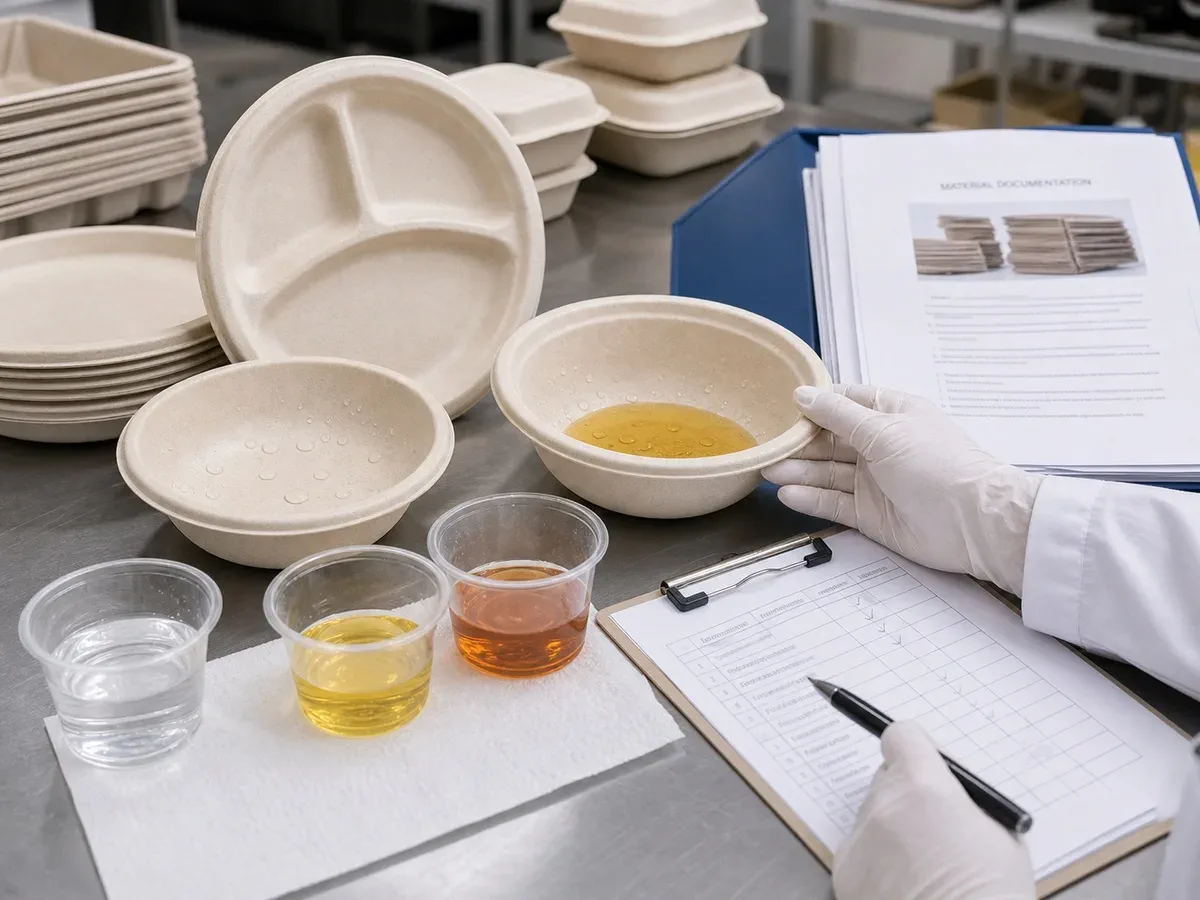
Agree a practical sample trial: food type, filling temperature, holding time, closure, stacking, transport and disposal instructions. Record observations against the exact container and lid combination. A room-temperature water trial cannot establish performance for hot oily or acidic food.
Microwave, freezer and oven suitability must be confirmed for the selected finished item and its instructions. This guide does not assign a universal temperature range or reheating time to bagasse products. If the material, coating or production specification changes, review whether earlier results still apply.
Review labels and environmental wording for each market
Use specific claims that the available evidence supports. Identify the item and disposal conditions, and verify permission before printing a certification logo. Avoid implying that a whole product range shares a property demonstrated only for selected products.
The FTC Green Guides summary explains why broad environmental claims need clear qualifications. EU buyers should separately review Directive (EU) 2024/825, national implementation and the rules in the country of sale. Specific national restrictions should not be generalized into a blanket EU-wide ban on every use of the word “biodegradable”. Nor is certification alone permission for any environmental claim.
A quick first-pass review of a supplier file
- Identify the item: record the SKU, dimensions, formulation, coating, lid and intended food use.
- Match the evidence: compare the sample description and documented product-family coverage with the order.
- Check dates and changes: confirm certificate validity and whether the formulation, process or applicable requirements changed. There is no universal two-year expiry rule for every test report.
- Verify independent records: check any certification in the issuer's directory and laboratory competence for the test methods requested. Do not rely only on a logo on a PDF.
- Close gaps before approval: record missing evidence, the responsible party, agreed sample trials and the acceptance criteria.
A short document check can identify obvious mismatches. It cannot replace a full assessment where the product, market or claim requires one.
Frequently asked questions
Does every SKU need its own laboratory certificate?
Not necessarily. Evidence may cover a documented product family where the composition and use conditions are appropriately represented. Ask the responsible supplier or laboratory to explain the coverage; do not infer it from a similar appearance or a shared material name.
Is compostability certification always mandatory?
The answer depends on the claim, certification mark, market and buyer contract. It is separate from food-contact obligations. Check the rules and evidence for the exact claim being made rather than treating voluntary certification as a universal import license.
Does a PFAS test prove the product contains no PFAS at all?
No. Read the analyte list, method, sample, units and reporting limits. Combine relevant testing with formulation information and any declaration required for the applicable rule or certification scheme.
Are all bagasse containers microwave safe?
No material-wide guarantee is appropriate. Confirm the finished product's instructions, food type, time, temperature and lid suitability, and test samples under the intended conditions before making a use claim.
Request documents for your selected products
EcoLeaderPack supplies bagasse tableware and coordinates product specifications, samples and available documentation. Certificate availability and applicability must be confirmed for the selected SKU, production site, certificate holder, destination market and validity period. This article does not assert that every item carries every certification mentioned.
Send the required formats, quantities, market, intended food use and claims with your inquiry. Browse bagasse tableware, packaging materials or contact our team to confirm the current scope.
Sources and editorial scope: Eco Leader Pack Editorial Team. Revised 25 October 2026 to distinguish legal requirements, buyer specifications and voluntary certification. The linked regulator and certifier guidance provides the source context; product-specific evidence must be checked with the supplier and, where needed, a qualified laboratory or adviser.
Request Bagasse Tableware Compliance Documentation & Samples
Specify the products, quantities, destination markets and intended food use. Our team can confirm available documents, their scope and sample options for the selected items.