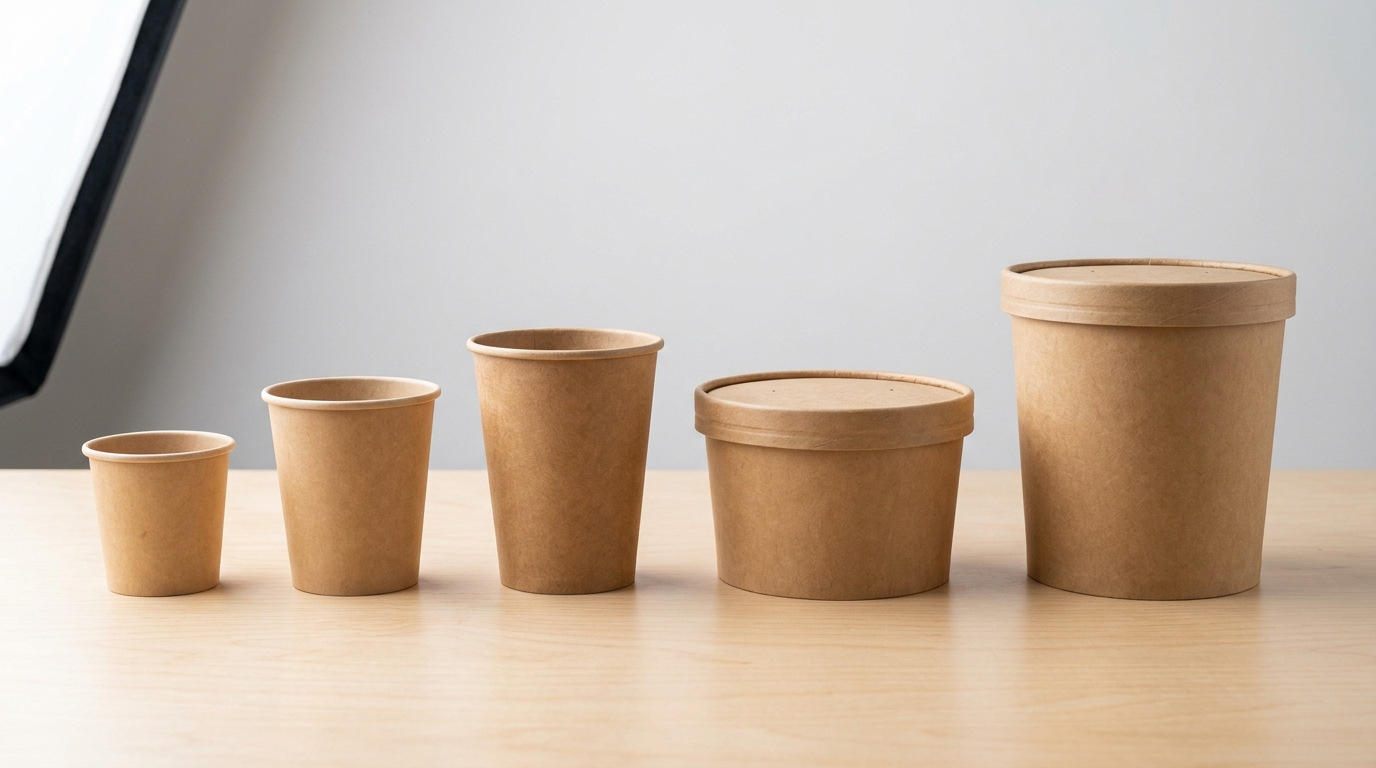
In commercial foodservice procurement, capacity is not a single number. Converting fluid ounces to milliliters and U.S. cups provides a mathematical baseline, but engineering tolerances, brimful overflow versus working fill, calibrated lid rim diameters, and transit hydrostatic dynamics determine the actual package specification you must order.
A purchase order specifying a generic “16 oz bowl” can result in operational failure if the kitchen serves 475 mL of steaming broth into a container whose brimful capacity is exactly 473 mL. The result is instant liquid overflow, burned staff fingers, compromised seam seals, and customer complaints.
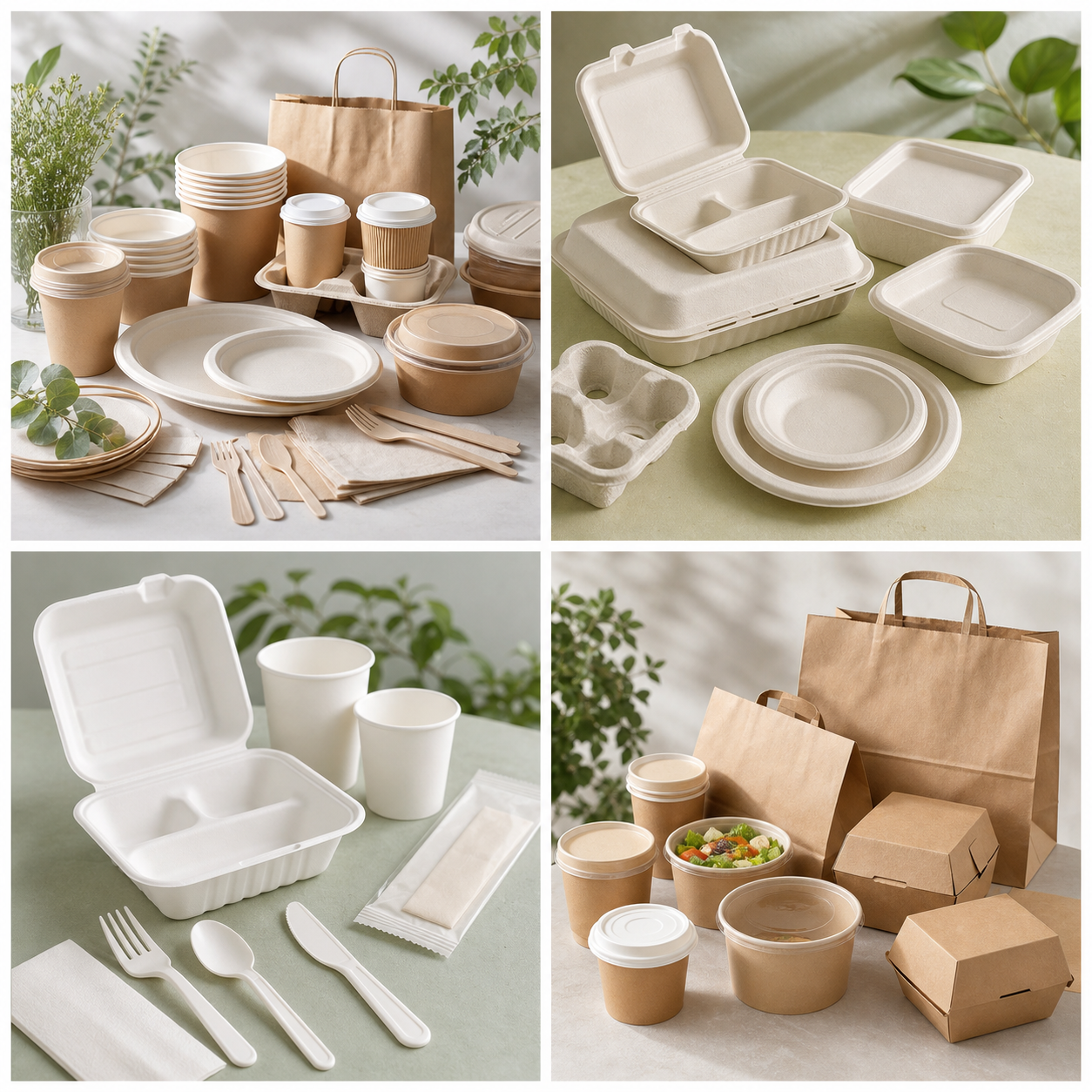
EcoLeaderPack manufactures and supplies precision-tooled paper cups, kraft paper soup bowls, and molded sugarcane bagasse containers engineered for international restaurant chains, food manufacturers, and commercial packaging distributors. This B2B guide provides exact legal metrology conversions, analyzes usable headspace, details universal rim diameter standards, and shows procurement teams how to eliminate costly cross-border sizing errors.
Standard Foodservice Capacity Conversions: oz, mL, and Cups
Under international legal metrology standards defined by the National Institute of Standards and Technology (NIST Handbook 133 and NIST Special Publication 811), liquid volume conversions are governed by fixed mathematical ratios:
- 1 U.S. Fluid Ounce (fl oz) = 29.5735295625 mL (≈ 29.574 mL).
- 1 U.S. Customary Cup = 8 U.S. fluid ounces = 236.588 mL (≈ 237 mL).
- Ounces to Milliliters: Multiply stated fluid ounces by 29.5735.
- Milliliters to Ounces: Divide milliliters by 29.5735.
- Ounces to U.S. Cups: Divide stated fluid ounces by 8.
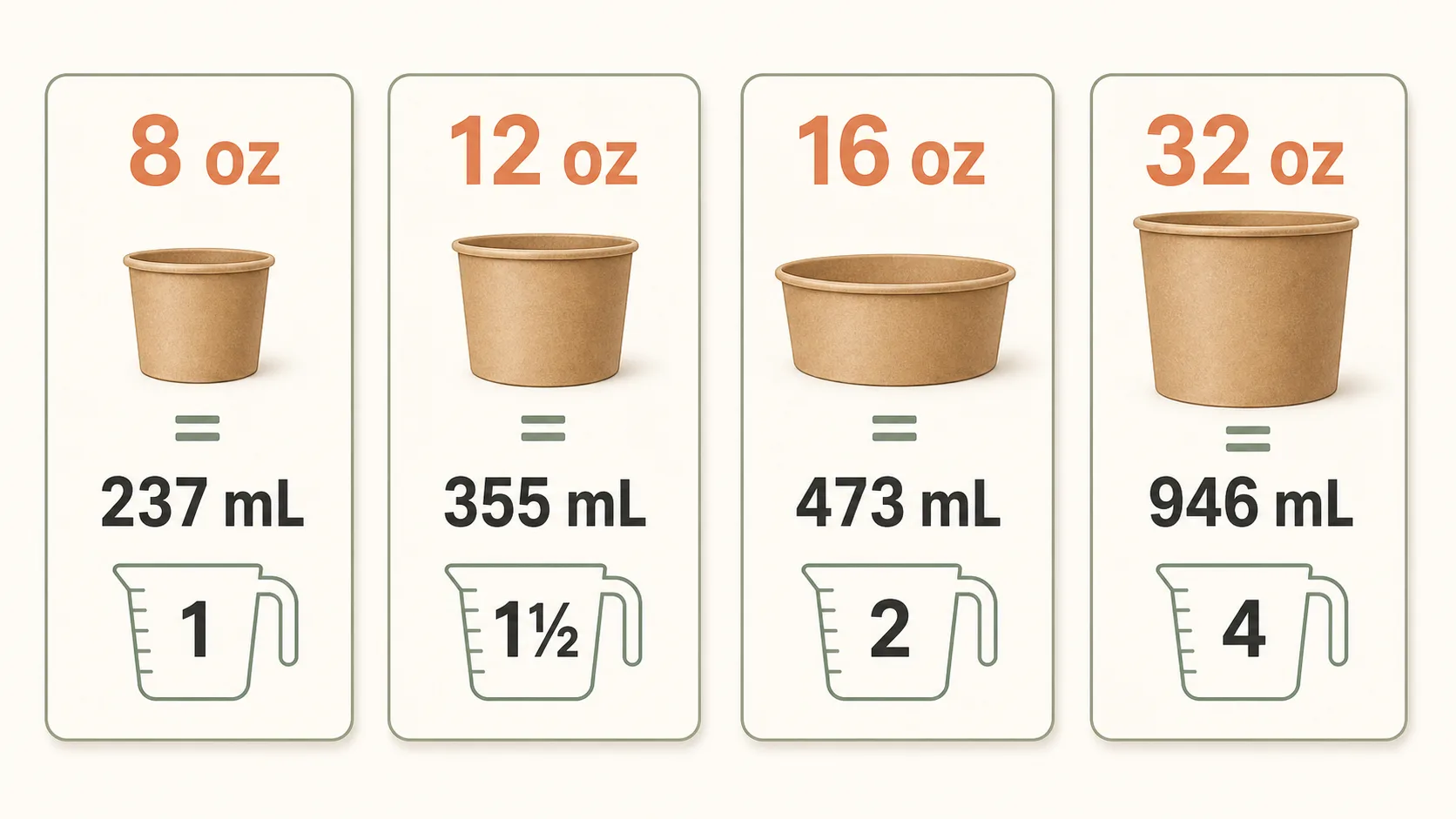
The conversion table below presents standard commercial foodservice capacities across small sampling portions, regular hot and cold beverages, soup bowls, and multi-portion takeaway containers, comparing mathematical brimful volume with practical working capacity.
| Nominal Size | Brimful mL | U.S. Cups | Safe Working Fill | Standard Foodservice Application |
|---|---|---|---|---|
| 4 oz | 118 mL | 0.50 cup | 95–105 mL | Espresso shots, condiments, dipping sauces, supermarket sampling |
| 6 oz | 177 mL | 0.75 cup | 145–155 mL | Flat whites, cortados, small side fruit cups, healthcare water service |
| 8 oz | 237 mL | 1.00 cup | 195–210 mL | Small hot coffee, cappuccino, side soups, small ice cream scoops |
| 10 oz | 296 mL | 1.25 cups | 245–260 mL | Standard Americano, fresh squeezed juice, side salads |
| 12 oz | 355 mL | 1.50 cups | 295–315 mL | Regular latte, tea, regular side soup cup, breakfast oatmeal |
| 14 oz | 414 mL | 1.75 cups | 345–365 mL | Specialty iced drinks, craft smoothies, specialty QSR beverage tiers |
| 16 oz | 473 mL | 2.00 cups | 390–420 mL | Large hot coffee, medium iced drinks, main dish soups, poke bowls |
| 18 oz | 532 mL | 2.25 cups | 440–470 mL | Large iced tea, boba milk tea, cold-brew coffee with ice |
| 20 oz | 591 mL | 2.50 cups | 490–525 mL | Extra-large hot coffee, large iced beverage, lunch grain salad bowls |
| 24 oz | 710 mL | 3.00 cups | 590–630 mL | Super-size iced drinks, takeaway ramen, noodle bowls, large dinner salads |
| 32 oz | 946 mL | 4.00 cups | 780–840 mL | Sharing soup tubs, family deli meals, takeout pho, bulk salad tubs |
*Note on legal volumetric definitions: These calculations reflect U.S. liquid measure. British Imperial fluid ounces equal 28.413 mL, while an Australian/New Zealand metric cup is standardized at 250 mL. Multinational restaurant brands must define the exact volumetric standard in supplier contracts.
Fluid Ounces vs. Dry Ounces: The Procurement Pitfall
One of the most persistent procurement errors in the restaurant supply chain is confusing fluid ounces (fl oz) with avoirdupois dry ounces (oz wt):
- Fluid Ounces (Volume): Measures the 3-dimensional physical capacity occupied by a liquid or solid. A 16 fl oz container holds 473 mL of water, broth, or airspace.
- Dry Ounces / Grams (Weight): Measures the gravitational mass of the contents. A 16 fl oz container filled with dense clam chowder may weigh over 18 dry ounces (510 g), while the same container filled with leafy organic baby spinach will weigh less than 3 dry ounces (85 g).
Packaging specifications must always designate liquid volume in fluid ounces or milliliters. When writing a bill of materials (BOM), never convert kitchen ingredient weights directly into container volume without determining the food’s bulk density (g/mL).
Brimful Capacity vs. Practical Working Fill: The Headspace Buffer
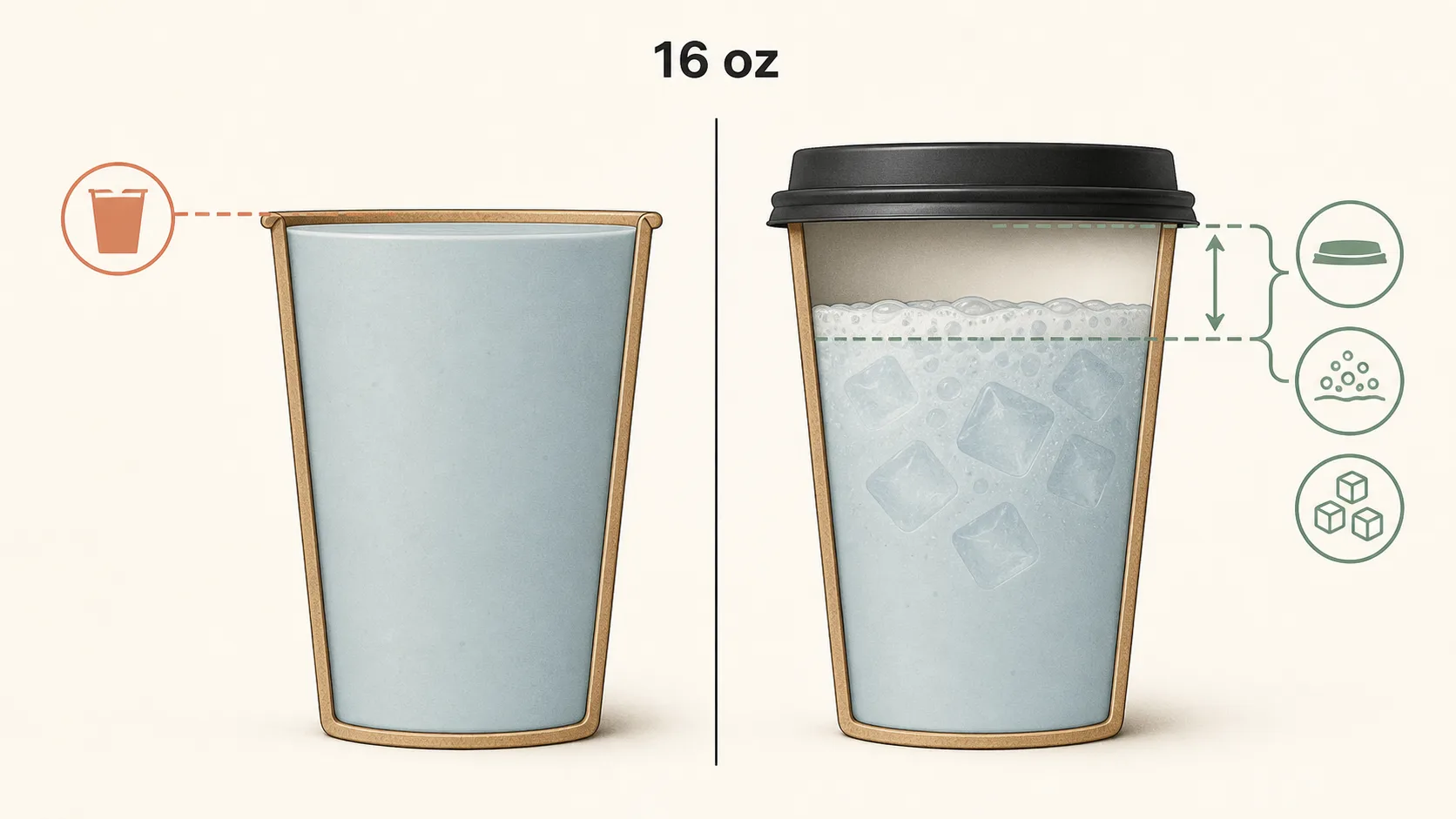
In container manufacturing, brimful capacity (overflow volume) represents the absolute volume of liquid required to fill the container until the meniscus breaks at the top lip edge. Working capacity represents the maximum volume of food or beverage that can be safely loaded, closed with a lid, and transported without spillage.
EcoLeaderPack engineers minimum recommended headspace buffers across each menu category:
- Hot Beverages (Coffee & Tea): 10%–15% Headspace Buffer. A 12 oz (355 mL) hot cup should carry no more than 300–315 mL of liquid. The remaining 40–55 mL provides clearance for the downward-protruding plug fit of travel sip lids, prevents sloshing over the drinker’s hands, and accommodates crema or steamed milk foam.
- Hot Soups & Braised Curries: 20%–25% Headspace Buffer. Liquid food expands when heated and sloshes vigorously during bike or car delivery. Filling an 800 mL soup order into an 850 mL bowl leaves inadequate headspace; thermal steam builds hydrostatic pressure against the lid, forcing broth through the rim seam. A main-dish soup of 750 mL requires a minimum 950–1000 mL (32 oz) container.
- Cold Drinks with Ice: Volumetric Displacement. In a 16 oz (473 mL) iced drink, adding 150 g of solid ice cubes displaces approximately 160 mL of liquid volume. The actual beverage poured by the barista is only ~310 mL. Specifying cup sizes for cold programs requires testing beverage syrup/milk ratios against ice machine pellet sizes.
Cup Sizing & Universal Rim Diameters: Consolidating Lid SKUs
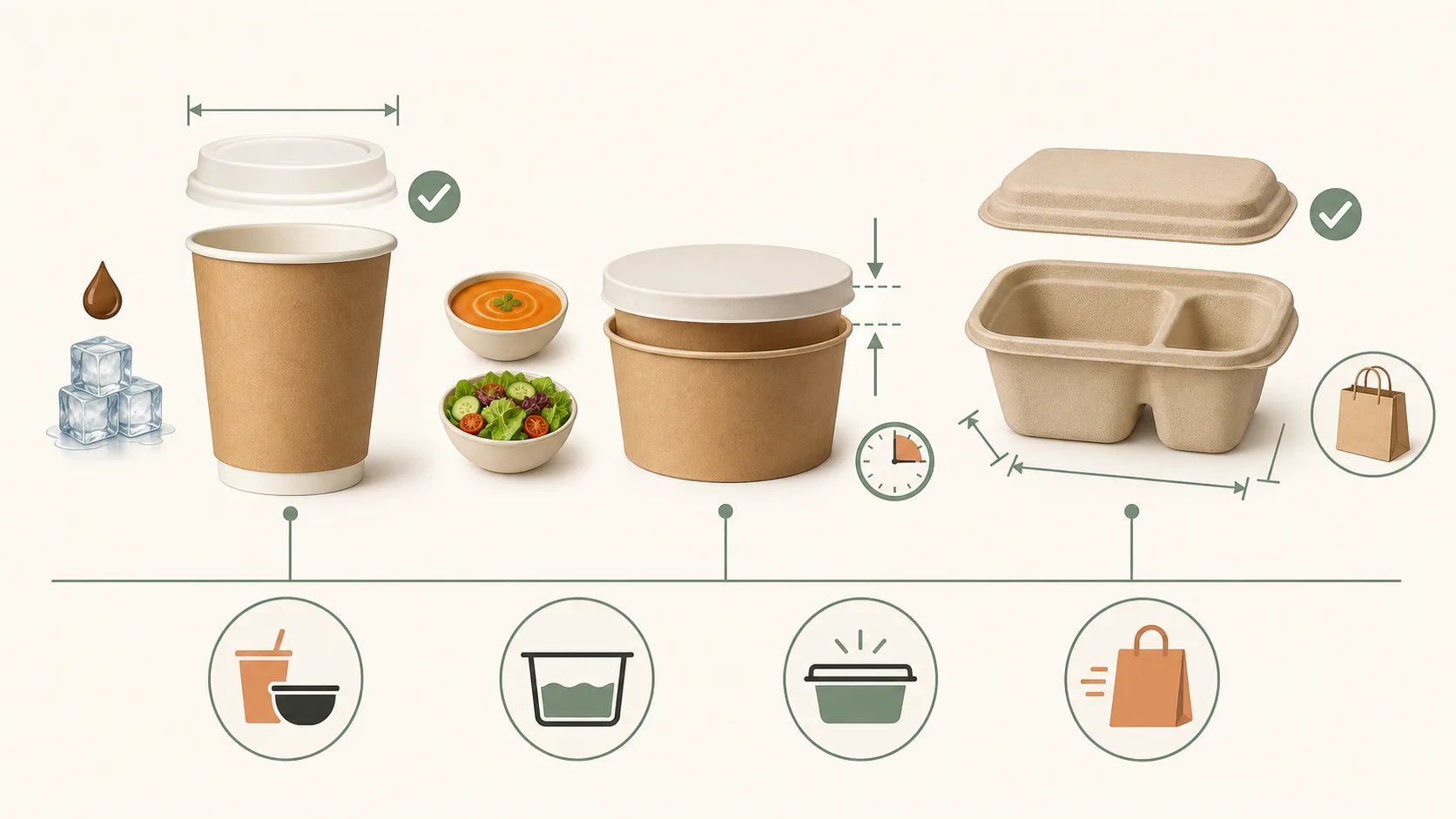
When procuring paper cups, container volume is only half the equation. The top rim diameter governs lid compatibility. Managing multiple cup sizes with different top diameters forces restaurants to stock multiple lid SKUs, driving up inventory costs, causing operational bottlenecks during rush hours, and increasing carton waste.
EcoLeaderPack engineers cup ranges to share standardized top rim tooling diameters:
- 62 mm Rim Diameter (Sampling & Espresso): Calibrated for 4 oz single-wall cups used for espresso, cortados, condiment dipping, and promotional retail sampling.
- 80 mm Rim Diameter (Small Hot Beverage): Standardized for 8 oz single-wall, double-wall, and ripple-wall cups.
- 90 mm Universal Rim Diameter (Core Hot Cup Platform): Standardized across 10 oz, 12 oz, 16 oz, 20 oz, and 24 oz hot cups. By maintaining a constant 90 mm rolled rim profile and altering only the cup height and bottom taper, EcoLeaderPack enables operators to use a single 90 mm sip lid SKU across 5 different drink sizes, reducing lid storage space and stock-outs by up to 60%.
- 92 mm / 98 mm Rim Diameter (Cold Cups): Standardized for thermoformed PLA, rPET, and double-PE paper cold cups, compatible with flat straw-slot lids, raised dome lids, and strawless sip closures.
EcoLeaderPack supplies matched paper cup lids in recyclable PP, rPET, molded sugarcane fiber, and home-compostable biobased resins, quality-audited for snap-fit engagement and leak resistance.
Paper Bowls: Balancing Diameter, Depth, and Lid Clearance
EcoLeaderPack manufactures kraft and white paper bowls for hot soups, ramen, poke, acai bowls, pasta, and frozen yogurt. Selecting the right bowl requires balancing diameter against depth:
- Squat 115 mm Universal Soup Platform (8 oz, 12 oz, 16 oz, 24 oz, 32 oz): These round bowls feature a heavy curled rim with an identical 115 mm top diameter across multiple depths. A single 115 mm vented paper or PP lid fits every capacity from 8 oz side soup to 32 oz large broth.
- Wide-Mouth 142 mm / 150 mm Salad & Meal Platform (500 mL, 750 mL, 1000 mL, 1300 mL): Main-course salads and grain bowls require a wide surface area (150 mm diameter) to display colorful protein toppings and permit customer dressing mixing without spilling over the side. A shallow, wide bowl creates superior visual value perception compared to a narrow, deep container of identical volume.
Molded Bagasse Containers: Footprints, Compartments, and Stacking
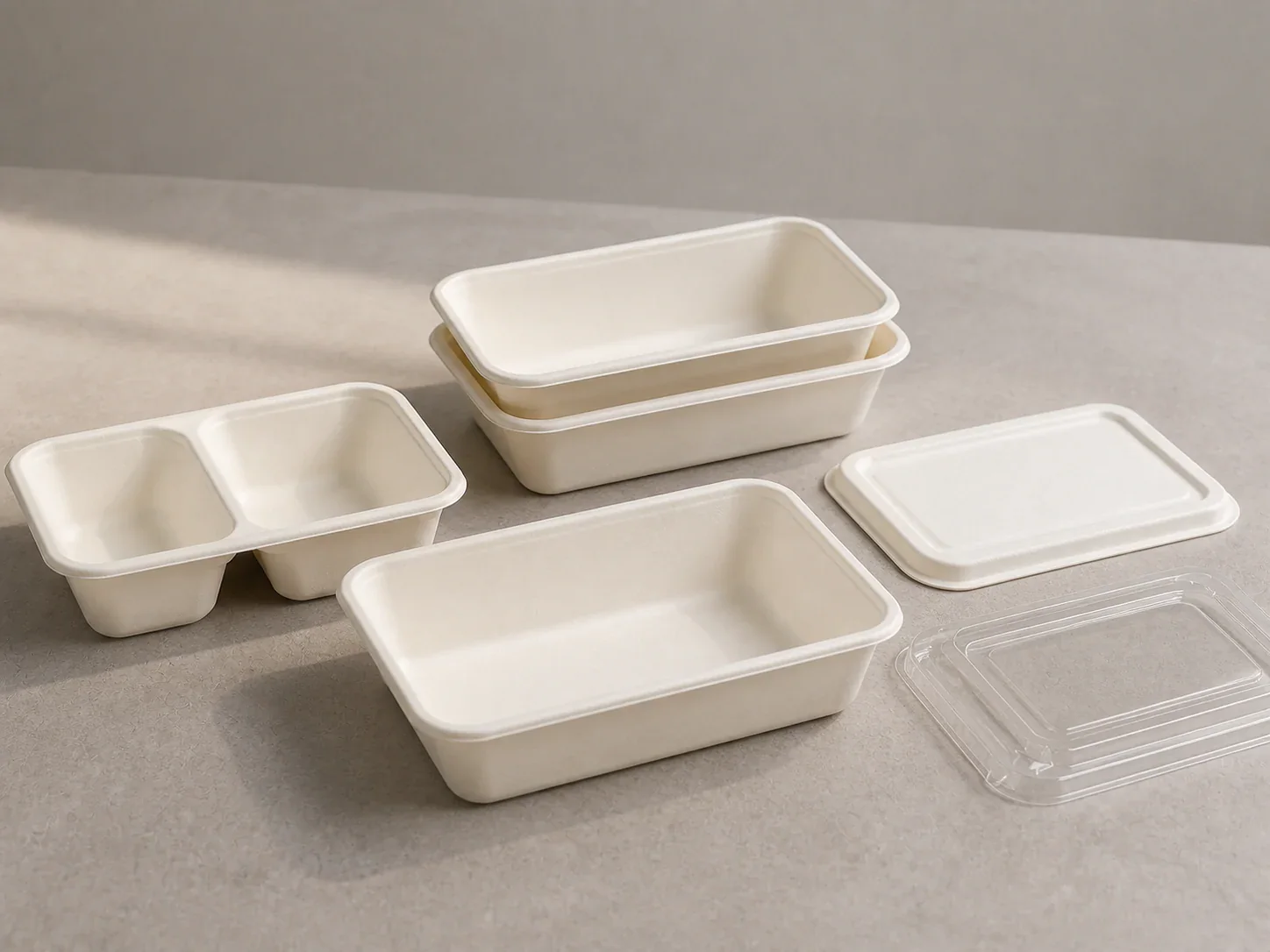
For hot, greasy, and multi-component prepared meals, molded sugarcane fiber delivers superior rigidity and thermal insulation. EcoLeaderPack manufactures three structural formats:
- Attached Hinged Clamshells (Bagasse Clamshell Containers): Eliminates the inventory hassle of matching separate lids. Standard industry formats include:
- 6×6 inch (Burger Clamshell): ~450–500 mL capacity; standard for gourmet burgers, hot sandwiches, and pastries.
- 8×8 inch (Medium Dinner Clamshell): ~900–1000 mL capacity; available in 1-compartment and 3-compartment (divided for main entree plus two sides).
- 9×9 inch (Large Meal Clamshell): ~1200–1350 mL capacity; heavy-duty format for barbecue, steak meals, and Caribbean/Asian platters.
- 9×6 inch (Oblong / Hoagie Clamshell): ~800–900 mL capacity; optimized for sub sandwiches, burritos, and fish & chips.
- Separate-Lid Base Containers (Bagasse Food Containers with Lids): Rectangular and oval bases (500 mL, 650 mL, 750 mL, 850 mL, 1000 mL) paired with high-clarity rPET/PP lids or molded bagasse lids. Ideal for supermarket deli meal prep and organized delivery stacking.
- Shallow Catering Trays (Bagasse Trays): Designed for party platters, institutional cafeteria lines, and bakery displays.
Metric vs. Customary: Cross-Border Procurement Pitfalls
When purchasing packaging for multinational operations or importing from Asian manufacturing hubs, nominal metric and imperial designations often appear interchangeable but differ significantly in practice.
| Common Comparison | Customary Volume | Metric Volume | Volume Discrepancy | Commercial Procurement Consequence |
|---|---|---|---|---|
| 8 oz vs. 250 mL | 8 fl oz = 237 mL | 250 mL = 8.45 fl oz | +13 mL (+5.5%) | A 250 mL European cup is taller than a standard US 8 oz cup. Standard 8 oz US lids will not seat correctly on European tooling. |
| 10 oz vs. 300 mL | 10 fl oz = 296 mL | 300 mL = 10.14 fl oz | +4 mL (+1.4%) | Close in volume, but bottom taper angles differ. Automatic vending or cup dispenser drop mechanisms may jam if tooling drawings are not reconciled. |
| 16 oz vs. 500 mL | 16 fl oz = 473 mL | 500 mL = 16.91 fl oz | +27 mL (+5.7%) | A European 500 mL deli tub holds 5.7% more product. Substituting a US 16 oz tub will result in customer underfill claims or lid overflow during capping. |
| 24 oz vs. 750 mL | 24 fl oz = 710 mL | 750 mL = 25.36 fl oz | +40 mL (+5.6%) | 750 mL requires a distinct mold footprint. Do not substitute 24 oz for 750 mL without adjusting the kitchen portion scoop. |
| 32 oz vs. 1000 mL (1 L) | 32 fl oz = 946 mL | 1000 mL = 33.81 fl oz | +54 mL (+5.7%) | A 32 oz container is NOT a full liter. Selling an imported 32 oz tub as a “1-liter family soup” violates weights and measures regulations in metric jurisdictions. |
To avoid supply disruptions, packaging specifications should state the exact calibrated capacity in milliliters alongside engineering drawing numbers rather than relying solely on colloquial ounce designations.
The 10-Point Technical Packaging Specification Blueprint
Before issuing a bulk purchase order or requesting manufacturing tooling, provide your supplier with a complete 10-point technical packaging data sheet:
- Target Menu Food / Liquid Type: Identify viscosity, acidity, alcohol content, and fat content per FDA Food Types.
- Serving Temperature Profile: Hot fill (85°C+), ambient room temperature, refrigerated storage (4°C), or commercial deep freeze (-20°C).
- Nominal vs. Brimful Volume: Target portion mass in grams, working fill line, and absolute brimful overflow in milliliters.
- Dimensional Tooling Limits: Top rim outside diameter (OD), bottom base diameter, overall vertical depth, and maximum carton packing height.
- Substrate & Barrier Chemistry: Unbleached virgin kraft, bleached SBS, thermoformed sugarcane bagasse, or water-based dispersion coating.
- Lid Closure Specification: Plug-fit sip lid, flat straw slot, dome lid, perimeter snap-fit bagasse lid, venting hole diameter, and matching item SKU code.
- Transit & Stacking Load: Delivery vehicle method, stack height in insulated delivery bags (e.g., 3-high dynamic load), and maximum holding time.
- Secondary Packaging & Case Pack: Pieces per sealed moisture-barrier poly sleeve, cartons per pallet, and carton crush test strength (ECT 44 / 200#).
- Branding & Graphic Decoration: Flexographic or offset printing, food-grade water-based or soy inks, full-bleed coverage, and Pantone matching.
- Regulatory Dossier & Destination: Market-specific compliance requirements (EU PPWR PFAS limits, FDA 21 CFR 176.170, FSC Chain of Custody certification).
Frequently Asked Questions: Foodservice Sizing
How many U.S. cups are in an 8 oz paper cup?
An 8 U.S. fluid ounce cup equals exactly 1.0 U.S. measuring cup (237 mL). For practical serving, usable liquid capacity is approximately 200–210 mL to accommodate lid seating and prevent spills.
Is a 16 oz container the same as a 500 mL container?
No. A 16 U.S. fluid ounce container equals approximately 473 mL. A 500 mL container is 16.91 fluid ounces—roughly 27 mL (5.7%) larger. The two sizes are not interchangeable without adjusting kitchen portioning or lid tooling.
What does a 90 mm universal rim diameter mean for paper cups?
A 90 mm universal rim means that 10 oz, 12 oz, 16 oz, 20 oz, and 24 oz hot cups share the identical top rolled edge diameter. This allows a restaurant or coffee shop to buy, store, and dispense a single lid SKU across all 5 drink sizes.
Why is a 32 oz container not equal to one liter?
Under NIST metrology standards, 32 U.S. fluid ounces converts to 946.35 mL, which is 53.65 mL short of a full metric liter (1,000 mL). Labeling a 32 oz container as a “1-liter pack” breaches trade measurement laws in the UK, EU, and Australia.
How much headspace should be left when packaging soup for delivery?
A minimum of 20% to 25% headspace is recommended for delivery soups and curries. For example, a 600 mL soup portion should be packaged in an 800 mL (26–28 oz) container to accommodate thermal expansion, steam generation, and vehicle motion without breaking the rim seal.
Request Matched Packaging Sizes, Tooling Drawings & Samples
Send EcoLeaderPack your menu portion weights, target volume, temperature conditions, and container preferences. Our packaging engineering team will provide precision CAD dimension drawings, matched cup-and-lid combinations, and physical production samples for testing.
Send Your Sizing & Bulk Packaging Requirements
Share your food application, target capacity (oz/mL), lid requirements, annual case forecast, and destination port. EcoLeaderPack will review matched tooling before quoting.