A 24 U.S. fluid ounce food container holds 709.76 mL, making it mathematically almost identical to 710 mL and significantly closer to 700 mL (approx. 10 mL delta) than to 750 mL (approx. 40 mL delta). However, in commercial foodservice and contract packaging procurement, capacity labels are brimful volumetric ratings rather than operational portion guarantees. A 700 mL slim rectangular container, a 750 mL deep bowl, and a 24 oz square salad container cannot be treated as interchangeable: they exhibit completely different footprint areas, fill depths, vertical stacking compression strengths, and rim closure geometries. Lids are precision-machined to specific tooling flange profiles and will not seal interchangeably across different formats or suppliers.
When multi-unit restaurant chains, food delivery brands, and corporate caterers transition between packaging suppliers or convert from plastic containers to molded sugarcane bagasse or kraft paper, procurement teams frequently make the mistake of treating 700 mL, 750 mL, and 24 oz as interchangeable SKU equivalents. A nominal 40 mL to 50 mL variance sounds negligible on an invoice, but in commercial kitchen operations it represents the difference between a secure snap-fit lid and a catastrophic liquid leak inside a courier's delivery backpack.
EcoLeaderPack manufactures precision-molded sugarcane bagasse tableware and kraft paper containers for international foodservice brands. This technical guide examines the volumetric mathematics, brimful vs. working fill dynamics, physical rim tolerances, thermal expansion behaviors, and legal compliance standards governing 700 mL, 750 mL, and 24 oz food containers.
1. Mathematical Volume Comparison (NIST Handbook 133)
In international trade, fluid volumes are standardized under legal metrology standards. According to the NIST Handbook 133 (Checking the Net Contents of Packaged Goods), one United States fluid ounce ($1\text{ U.S. fl oz}$) is defined as precisely $29.57353\text{ mL}$. Using this statutory factor:
- 700 mL = $23.669\text{ U.S. fl oz}$ ($\approx 23.7\text{ oz}$)
- 24 U.S. fl oz = $709.765\text{ mL}$ ($\approx 710\text{ mL}$)
- 750 mL = $25.361\text{ U.S. fl oz}$ ($\approx 25.4\text{ oz}$)
Swipe horizontally to compare volumetric metrics.
| Catalogue Size Label | Equivalent Metric Volume | Equivalent Imperial Volume | Variance from 24 U.S. fl oz | Procurement Interpretation |
|---|---|---|---|---|
| 700 mL | 700.00 mL | 23.67 U.S. fl oz | $-9.76\text{ mL}$ ($-1.38\%$) | Practically identical nominal capacity to 24 oz; easily accommodated in existing portioning lines. |
| 24 U.S. fl oz | 709.76 mL | 24.00 U.S. fl oz | $0.00\text{ mL}$ (Reference) | The standard North American retail deli and meal-prep benchmark volume. |
| 750 mL | 750.00 mL | 25.36 U.S. fl oz | $+40.24\text{ mL}$ ($+5.67\%$) | Noticeably larger brimful capacity ($+7.14\%$ vs. 700 mL); requires portion re-calibration to avoid food cost creep. |
While 700 mL and 24 oz sit within a narrow 10 mL margin, stepping up to 750 mL adds 40 mL to 50 mL of total capacity. In high-volume commercial dining, an unmonitored 40 mL over-portioning across 10,000 weekly takeout orders represents 400 liters of unaccounted food cost.
2. Brimful Capacity vs. Safe Working Fill
Packaging catalogues universally list brimful capacity—the absolute volume of water the container holds when filled level with the uppermost rim perimeter. Commercial food preparation never operates at brimful capacity. In practical kitchen operations, a container must maintain adequate headspace to prevent:
- Food pressing against the underside of the lid, causing condensation pooling and soggy garnishes.
- Sauces, oils, and broths spilling over the rim during manual lid application on fast-paced packing lines.
- Hydraulic pressure surges forcing the lid seal open when containers are compressed in multi-drop insulated delivery courier bags.
The 75%–85% Culinary Working Fill Rule
EcoLeaderPack packaging engineers advise buyers to apply the standardized working fill formula based on food rheology:
- Liquid & Sauced Foods (Soups, Curries, Stews): Fill to a maximum of $75\%\text{ to }80\%$ of brimful capacity. For a 750 mL container, the safe working liquid portion is 560 mL to 600 mL ($19\text{ to }20\text{ oz}$), leaving 12–15 mm of vertical headspace.
- Dense Solid Foods (Rice Bowls, Pasta, Noodles): Fill to $80\%\text{ to }85\%$ of brimful capacity. A 700 mL container safely holds 560 mL to 595 mL of packed food.
- Low-Density Volumetric Foods (Crisp Leaf Salads): Salads can fill $90\%\text{ to }95\%$ of brimful volume, but require a wide, shallow bowl footprint so dressings can be tossed without crushing tender greens.
3. Confirmed EcoLeaderPack Format Matrix
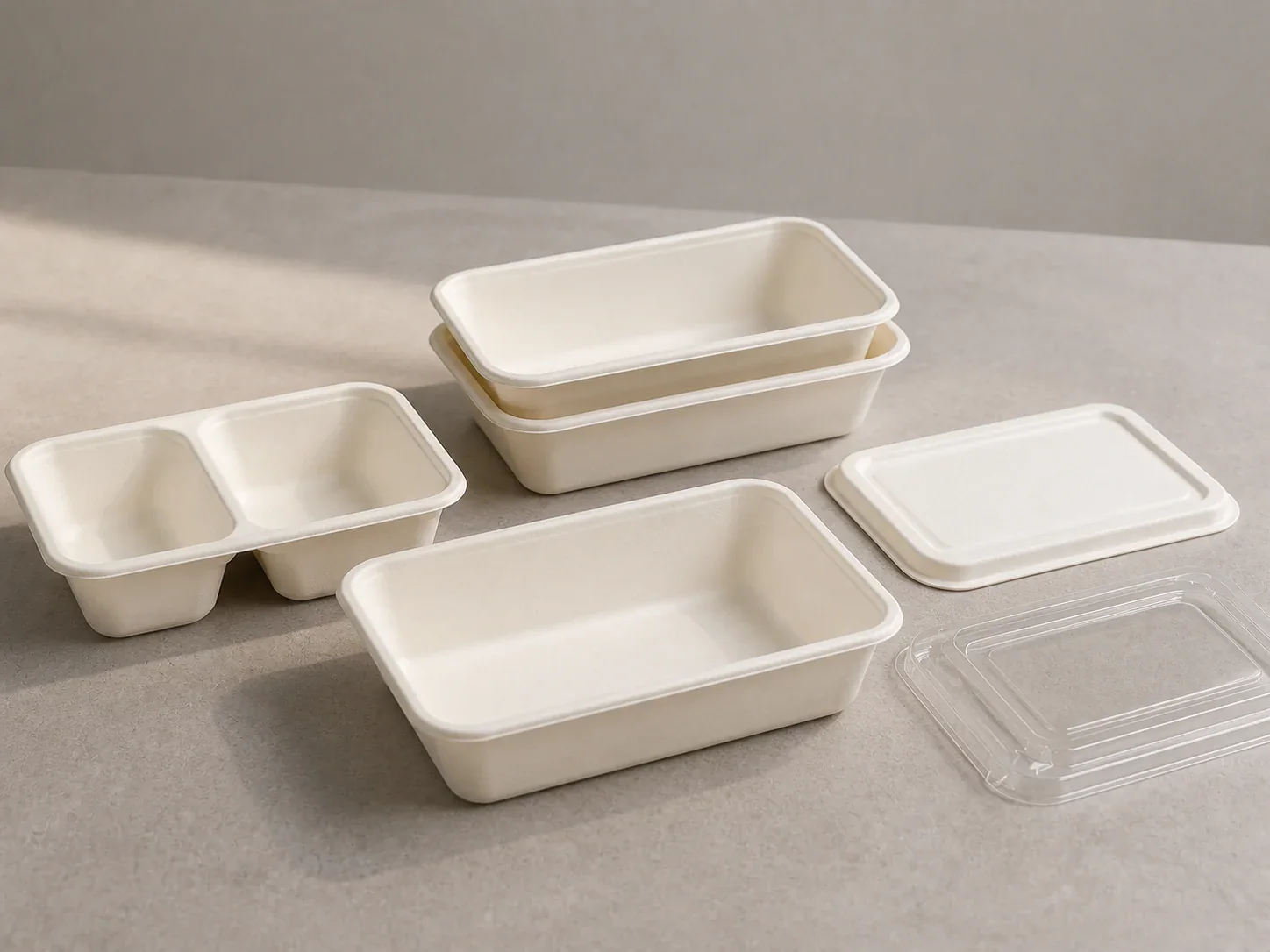
The engineering matrix below illustrates why volume alone cannot define an order. EcoLeaderPack manufactures multiple 700 mL, 750 mL, and 24 oz containers, each engineered for distinct culinary and merchandising operations.
Swipe horizontally to examine dimensions, tare weights, and carton packing densities.
| Product Format & Substrate | Nominal Size | Exterior Dimensions ($L \times W \times H$) | Unit Tare Weight | Carton Pack | Structural Architecture & Use Case |
|---|---|---|---|---|---|
| Kraft Paper Salad Bowl | 750 mL (26 oz) | $150\text{ mm top } \times 128\text{ mm base } \times 60\text{ mm depth}$ | 14.5 g (Base) | 300 pcs/ctn | Round rolled rim, PE/aqueous barrier; ideal for grain bowls, poke, and fresh salads. |
| Compact Bagasse Container | 750 mL | $180 \times 125 \times 64\text{ mm}$ | 18.0 g | 500 pcs/ctn | Deep rectangular cavity; minimal prep-table footprint; excellent for noodle dishes and curries. |
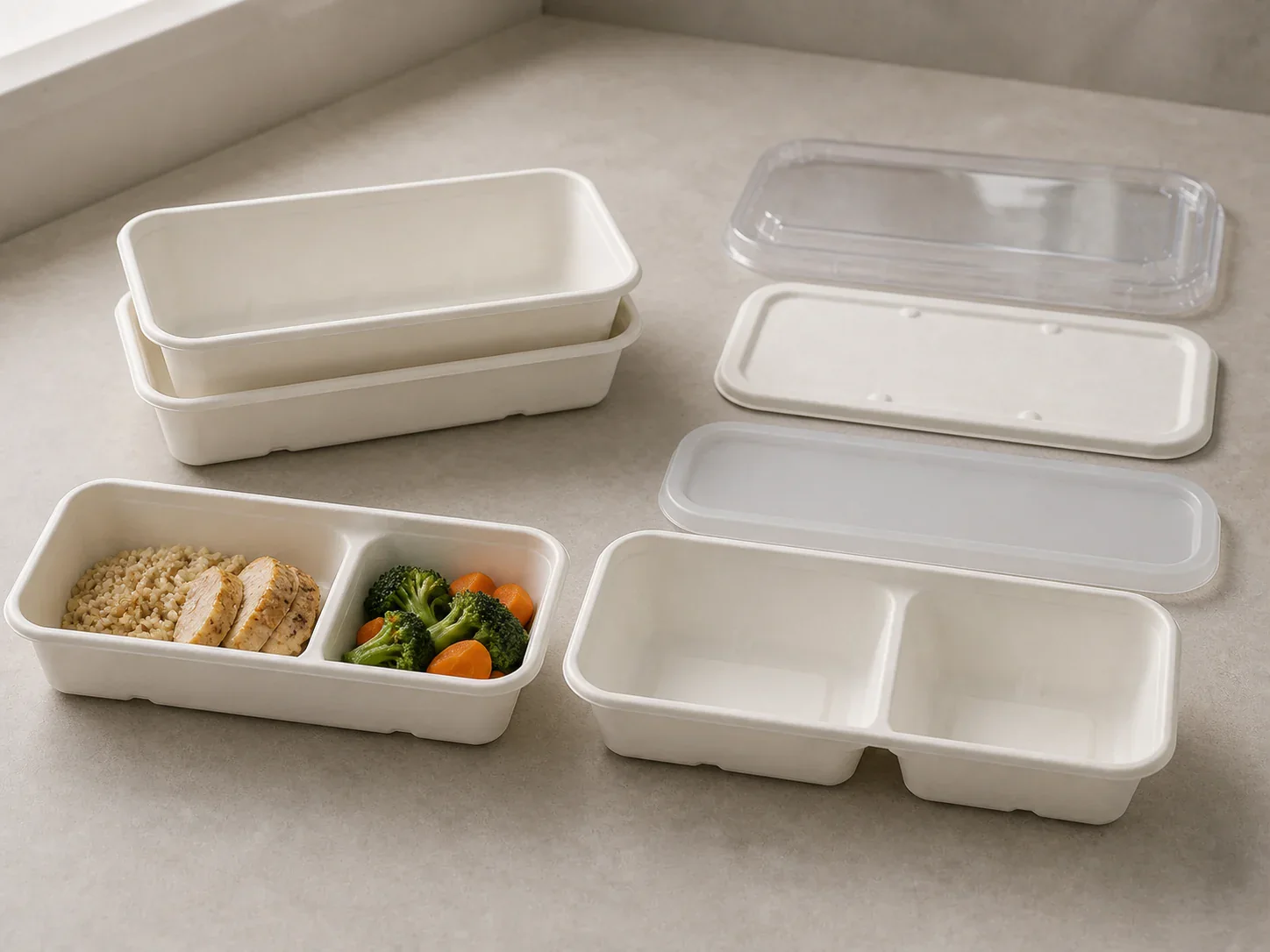
| Slim Bagasse Container | 700 mL | $195 \times 115 \times 50\text{ mm}$ | 16.0 g | 500 pcs/ctn | Elongated slim profile; fits standard meal-prep sleeves; available in 1-cavity and 2-compartment bases. |
| Standard Bagasse Container | 750 mL | $229 \times 134 \times 44\text{ mm}$ | 19.0 g | 500 pcs/ctn | Broad, shallow presentation; maximizes visual perceived value of sliced proteins and combo meals. |
| Square Bagasse Bowl | 24 U.S. fl oz | $180 \times 180 \times 54\text{ mm}$ | 23.0 g | 300 pcs/ctn | Wide square base ($710\text{ mL}$); superior anti-tip stability during transport; popular for fast-casual dining. |
| Round Bagasse Bowl | 24 U.S. fl oz | $\varnothing 170\text{ mm top } \times 58\text{ mm depth}$ | 15.0 g | 400 pcs/ctn | Deep circular bowl ($710\text{ mL}$); optimized for hot broth soups, ramen, and acai bowls. |
Kraft Paper Bowls
Round kraft and white paper food containers featuring precision rolled rims and heat-resistant lids. Suitable for salads, poke bowls, and hot noodle broths with aqueous barrier options.
View paper bowl optionsMolded Bagasse Containers
Sugarcane fiber rectangular, square, and compartment meal containers with matched compostable fiber and clear rPET lids. Oven-safe, microwaveable, and certified PFAS-free.
View bagasse container options4. Geometry & Structural Mechanics: Footprint vs. Depth
Two containers possessing identical $750\text{ mL}$ brimful capacity behave completely differently in transit due to structural mechanics:
- Visual Portion Perception (Plating Area): The 750 mL standard container ($229 \times 134\text{ mm}$) provides an internal floor area of approximately $245\text{ cm}^2$. The 750 mL compact container ($180 \times 125\text{ mm}$) provides only $180\text{ cm}^2$ of floor area. A 400 g serving of protein and rice looks abundant and lavish in the shallower, broader container, but appears sunken and small in the deep compact container.
- Chilled Display & Delivery Logistics: The slim 700 mL format ($195 \times 115\text{ mm}$) allows retail grab-and-go operators to place 5 rows of product across a standard 600 mm refrigerated display shelf, whereas the square 24 oz format ($180 \times 180\text{ mm}$) accommodates only 3 rows, reducing shelf revenue per linear meter by 40%.
- Top-Load Compressive Resistance (ASTM D642-20): When meal delivery couriers stack 4 containers in an insulated backpack, bottom containers support up to $3\text{ kg}$ of vertical static load, plus dynamic G-forces from road vibration. Round bowls naturally distribute vertical load uniformly across their continuous circular wall perimeter, achieving higher top-load crush strength (>250 N) than rectangular containers of identical grammage.
- Divided Compartments: A 2-compartment 700 mL container typically allocates $450\text{ mL}$ to the primary cavity and $250\text{ mL}$ to the secondary side cavity. Sourcing teams must ensure the side portion matches culinary volume, as the central divider wall consumes 15 mL to 20 mL of displacement volume.
5. Menu & Portion Alignment: Salads, Curries, Bowls
Align the geometric format directly with your menu items:
Swipe horizontally to view culinary menu alignments.
| Food Category | Recommended Format | Optimal Size Label | Critical Engineering Features |
|---|---|---|---|
| Poke & Grain Bowls | Round Paper Bowl or Round Bagasse Bowl | 750 mL / 24 oz | Wide opening ($\varnothing \ge 150\text{ mm}$) for ingredient display; anti-fog clear lid for retail merchandising. |
| Indian / Thai Curries & Stews | Compact Deep Bagasse Container | 700 mL or 750 mL | High vertical wall ($H \ge 60\text{ mm}$) to minimize liquid sloshing; high oil barrier (>100°C resistance). |
| Western Meal Prep (Protein + Carbs + Veg) | 2-Compartment Slim Bagasse Container | 700 mL | Integral divider prevents sauce crossover; fits standard paperboard packaging sleeves. |
| Asian Noodle Soups / Ramen | Round Bagasse Bowl with Inner Tray | 24 oz / 750 mL | Two-tier design separating noodles from broth; high rigidity under boiling liquid (+100°C). |
| Crisp Green Salads | Square Bagasse Bowl | 24 U.S. fl oz | Broad surface allows consumer to toss dressing without spillage; rigid corner ribs prevent sidewall buckling. |
For banquet catering or shared party platters requiring broad, shallow presentation rather than individual portions, explore EcoLeaderPack's bagasse tray range.
6. Lid Closure Engineering & Leak Testing (ASTM D3078)
The most dangerous procurement assumption is: "If two containers both say 750 mL, they can share the same lid." They cannot.
Why Tooling Dimensions Differ Across Suppliers
Molded sugarcane bagasse packaging is produced by vacuum-drawing a wet cellulose slurry (approx. 98% water, 2% fiber) onto CNC-machined metal wire molds, followed by transfer into heated hydraulic pressing dies at 180°C–210°C. During drying, the plant fibers contract, resulting in a thermal and moisture shrinkage rate of 1.5% to 2.5%. Tooling engineers incorporate specific draft angles (typically 1.5° to 3.0°) and perimeter shrinkage allowances unique to their specific tooling steel and press cycle. A bagasse base from Supplier A will have a rim flange perimeter variance of ±0.8 mm compared to Supplier B, rendering cross-supplier lid fits loose and leak-prone.
Lid Materials & Thermal Expansion Physics
EcoLeaderPack pairs containers with three distinct lid substrates:
- Polypropylene (PP) Lids: Operating temperature $-20^\circ\text{C}$ to $+120^\circ\text{C}$. Microwave safe and flexible. However, PP has a high coefficient of thermal expansion. Under boiling liquids, the rim expands slightly. To prevent seal failure, EcoLeaderPack engineers an undercut snap-bead interference lock that tightens against the outer container flange under internal steam pressure.
- Recycled PET (rPET) Lids: Exceptional optical clarity and gloss. However, rPET softens at temperatures exceeding $+60^\circ\text{C}$ ($140^\circ\text{F}$). It is strictly recommended for cold poke bowls, sushi, and ambient salads. Applying an rPET lid to hot pasta will cause the lid to warp and collapse inward.
- Molded Sugarcane Bagasse Lids: 100% plastic-free and commercially compostable under ASTM D6868-21. Features zero thermal deformation up to $+150^\circ\text{C}$. Requires high hydraulic precision during thermoforming to achieve a secure friction-fit seal.
Laboratory Seal Leak Integrity Testing
To verify leak resistance before mass production, EcoLeaderPack evaluates lid closures against international packaging standards:
- ASTM D3078-21 (Bubble Emission Test): The filled, capped container is submerged in a clear acrylic vacuum chamber. A vacuum of $12.5\text{ inHg}$ to $18.5\text{ inHg}$ is pulled. Continuous streams of air bubbles from the rim indicate defective snap engagement or micro-channels.
- ASTM D4991-21 (Rigid Container Vacuum Leak Testing): Verifies seal stability during simulated air cargo transit or mountain road distribution.
- 45-Degree Incline & Inversion Static Hold: Filled with hot dyed vegetable broth at 85°C, turned 45 degrees for 30 minutes, and inverted for 10 minutes to verify zero droplet penetration.
7. Food Safety & PFAS-Free Compliance
Regulatory authorities worldwide have banned or restricted per- and polyfluoroalkyl substances (PFAS) historically used in molded pulp tableware for oil and grease resistance:
- United States State Legislation: California enacted AB 1200 (Safer Food Packaging and Cookware Act), prohibiting plant-fiber food packaging containing intentionally added PFAS or total organic fluorine exceeding 100 ppm. Similar bans are enforced in New York, Washington, Colorado, and Oregon.
- European Union Framework: Under the EU PPWR (Regulation (EU) 2025/40) Article 5, food contact packaging cannot contain PFAS above trace contamination limits (<25 ppb). Packaging must satisfy safety criteria under Regulation (EC) No 1935/2004.
- FDA Extraction Compliance: Paper containers must satisfy FDA 21 CFR 176.170 for aqueous and fatty food contact. EcoLeaderPack utilizes proprietary, third-party certified 100% PFAS-free aqueous barrier coatings that achieve a kit rating of 7–9 without fluorinated chemistry.
8. Technical RFQ Sourcing Checklist
To receive an exact, production-ready quotation from EcoLeaderPack or any certified packaging manufacturer, provide these eight technical parameters:
- Target Volume & Standard: 700 mL, 750 mL, or 24 U.S. fl oz (brimful specification).
- Menu Composition & Temperature: Specific food item, liquid/solid ratio, sauce oil level, and peak serving temperature (e.g., 85°C curry vs. 4°C poke).
- Base Material & Barrier: Unbleached natural kraft paper (state GSM + barrier coating) or molded sugarcane bagasse (virgin unbleached or bleached, certified PFAS-free).
- Spatial Geometry: Rectangular compact, rectangular slim, rectangular standard, square bowl, or round bowl. Single cavity or divided (specify compartment volume ratio).
- Lid Specification: Microwaveable PP with steam vent, high-clarity rPET (cold only), or 100% compostable molded bagasse.
- Transit & Stacking Load: Delivery method (dine-in, curbside pickup, or 3rd-party scooter delivery), required stacking height (minimum 3 units high).
- Compliance Documentation Required: FDA 21 CFR 176.170 report, EU 1935/2004 Declaration of Compliance, total fluorine / PFAS-free lab test (EN 14582 / combustion ion chromatography), and BPI / EN 13432 compostability certificates.
- Order Volume & Logistics: Total order volume, SKU breakdown, carton packing limits, and target Incoterms (FOB Ningbo/Shenzhen or DDP).
9. Frequently Asked Questions
Is a 24 oz food container closer to 700 mL or 750 mL?
A 24 U.S. fluid ounce container holds 709.76 mL (NIST Handbook 133). Therefore, it is roughly 10 mL larger than a 700 mL container, but roughly 40 mL smaller than a 750 mL container. In volumetric terms, 24 oz is significantly closer to 700 mL.
Can I put a 750 mL paper bowl lid onto a 750 mL bagasse container?
No. Even though both hold 750 mL of brimful liquid, a round paper bowl uses a 150 mm rolled rim, whereas a rectangular bagasse container features an 180 × 125 mm flat flange rim. Lids match the specific tooling perimeter and flange bead of a product family, never the volumetric capacity label.
What is the safe working fill of a 750 mL container for takeaway delivery?
For hot liquids, curries, and soups, the safe working fill is 75% to 80% of brimful capacity, or 560 mL to 600 mL. This leaves 12 to 15 mm of headspace below the rim, preventing liquid from touching the lid seal during courier transport and avoiding lid-popping caused by trapped steam pressure.
Are bagasse food containers microwave safe?
Yes. EcoLeaderPack molded sugarcane bagasse containers withstand temperatures from -20°C to +120°C, making them fully safe for microwave reheating and conventional oven warming (up to 180°C for short durations). However, if paired with a clear rPET lid, the lid must be removed prior to microwaving, as rPET deforms at temperatures above 60°C.
Are EcoLeaderPack bagasse containers certified PFAS-free?
Yes. In full compliance with California AB 1200, New York state environmental statutes, and EU PPWR Article 5, EcoLeaderPack manufactures molded bagasse tableware using certified fluorine-free barrier formulations tested to below detectable limits (<50 ppm total fluorine per EN 14582).
What is the standard carton pack size for 750 mL containers?
Standard export packing for 700 mL to 750 mL rectangular bagasse containers is 500 pieces per master carton (typically packed in inner sleeves of 50 or 125 pieces). For round kraft paper bowls, standard packing is 300 pieces per carton due to nested stack nesting height.
Request 700 mL, 750 mL or 24 oz Container Samples or a Bulk Quotation
EcoLeaderPack supplies certified paper and molded sugarcane bagasse packaging to global restaurant groups and packaging distributors. Submit your target format, intended menu item, estimated order quantity, and destination market below. Our packaging engineering desk will verify drawing tolerances, recommend optimal lid pairings, and issue a commercial quotation within 24 business hours.
Request Food Container Samples or a Bulk Quote
Direct factory supply with certified ISO 9001, BRCGS, and food-contact compliance. Share your project requirements below.