Selecting the correct paperboard for packaging boxes requires balancing four technical engineering variables: product weight and transit compression, surface print reproduction (dot gain and coating smoothness), food-contact regulatory compliance, and raw material conversion cost. Folding cartons for cosmetics, FMCG, and dry food predominantly utilize white cardboard—specifically Folding Boxboard (FBB / GC1) or Solid Bleached Sulfate (SBS) at 250–400 GSM. Heavy retail gift boxes rely on rigid greyboard cores (1.5–3.0 mm caliper) wrapped in coated art paper. E-commerce and industrial shipping cartons mandate corrugated micro-flute (E/F-flute) or double-wall boards. When direct food contact is required, materials must be certified to US FDA 21 CFR 176.170 or German BfR Recommendation XXXVI; recycled duplex board with grey back must never touch fatty or moist food without an impermeable functional barrier.
For packaging procurement specialists, brand managers, and contract packagers, paperboard specification errors cause expensive production downtime. Specifying a board with insufficient Taber stiffness causes cartons to bulge on high-speed cartoning lines. Ignoring fiber grain direction causes coated surfaces to crack unsightly along fold scores. Selecting an uncertified recycled grade for direct food contact risks regulatory customs rejection and severe brand contamination from mineral oil hydrocarbons (MOSH/MOAH). Material selection is the single largest cost component in carton manufacturing, representing 55% to 70% of total unit manufacturing cost.
EcoLeaderPack manufactures custom-printed paper packaging boxes, rigid gift sets, and tissue box systems. This comprehensive guide compares 10 primary paperboard grades by pulp composition, caliper, bending stiffness, printability, and food compliance so you can write technically exact specifications before commissioning cutting dies or requesting production-run samples.
1. Technical Fundamentals: Grammage, Caliper & Stiffness
Paperboard is technically defined as paper materials with an aerial mass density (basis weight) exceeding $224\text{ g/m}^2$ ($140\text{ lb}/3{,}000\text{ ft}^2$) or a caliper thickness exceeding 300 microns (12 points / 0.012 inches). Three physical parameters govern box integrity:
- Grammage (Basis Weight): Measured according to ISO 536:2019 or TAPPI T 410, expressed in grams per square metre ($\text{g/m}^2$ or GSM). Grammage dictates mass, freight cube weight, and baseline raw material cost.
- Thickness (Caliper): Measured in microns ($\mu\text{m}$) or points ($1\text{ pt} = 0.001\text{ inch} = 25.4\ \mu\text{m}$) per ISO 534:2011 or TAPPI T 411. Two boards with identical GSM can exhibit significantly different calipers depending on their bulk density ($\text{cm}^3/\text{g}$). Mechanical pulp provides higher bulk and caliper per gram than dense chemical pulp.
- Bending Resistance (Stiffness): Tested via constant rate of deflection under ISO 2493-1:2010 or TAPPI T 489 (Taber-type stiffness, reported in mN or Taber units). Bending stiffness determines carton bulge resistance during automatic filling and top-to-bottom compression resistance when cartons are stacked in retail shipper cases.
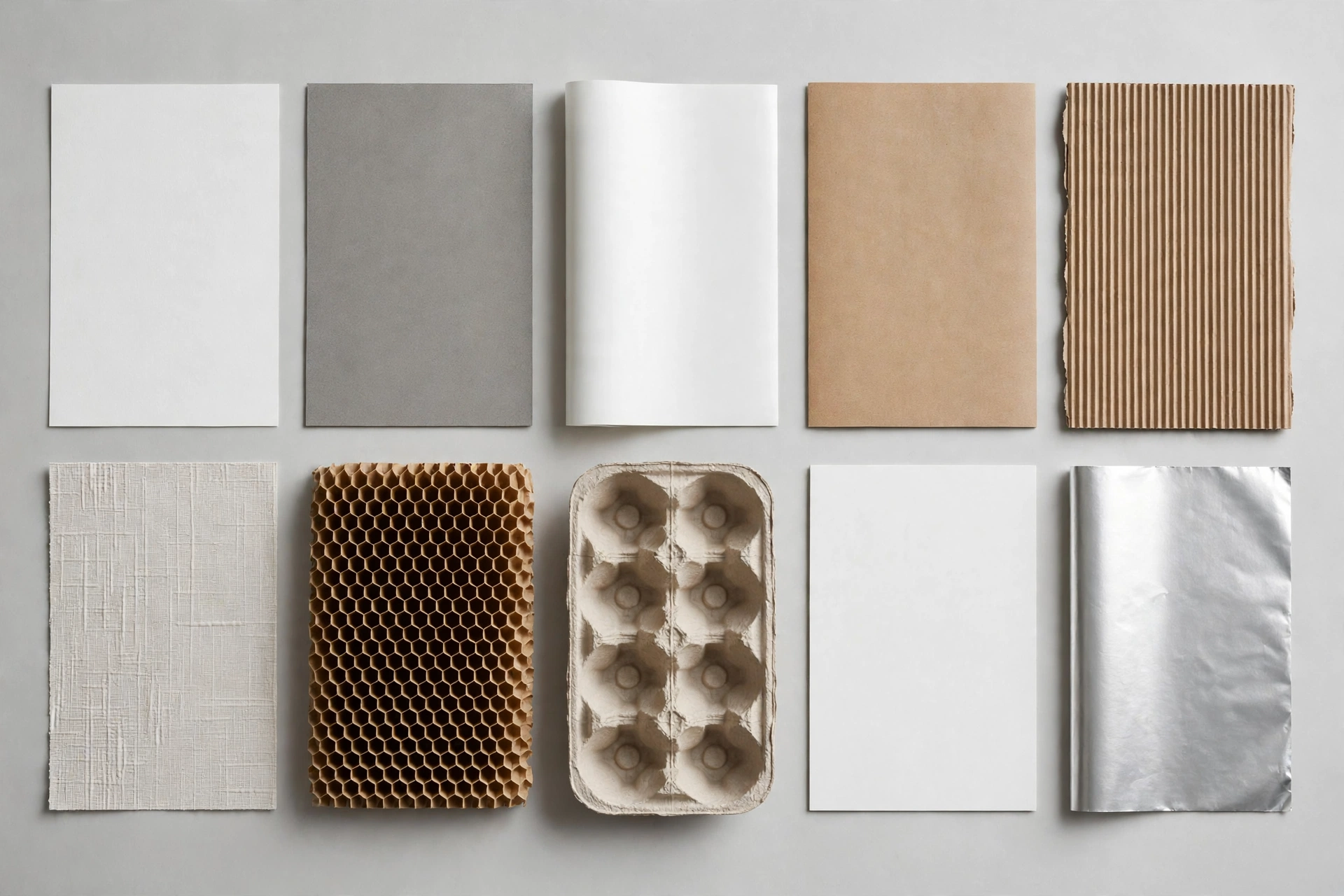
2. 10 Paperboard Types at a Glance (Comparison Matrix)
Swipe horizontally to view full technical specifications, pulp composition, and relative costs.
| Paperboard Grade | International Trade Classification | Pulp Composition | Standard Caliper / GSM Range | Print Reproduction | Cost Index | Primary Packaging Applications |
|---|---|---|---|---|---|---|
| 1. White Cardboard | FBB (GC1/GC2) / SBS (GZ) | 100% Virgin chemical pulp (SBS) or chemical plies with mechanical core (FBB) | 250–400 GSM (320–550 µm / 13–22 pt) |
Superior (ISO 12647-2 litho offset) |
Medium | Cosmetics, pharmaceutical cartons, premium food boxes, custom tissue boxes |
| 2. Greyboard | Chipboard / Binders Board | 100% Recycled recovered mixed paper & newsprint (multi-ply) | 1.2–3.0 mm (800–2,000 GSM) |
Not printed directly (requires wrap) | Low–Med | Rigid luxury gift boxes, board game boxes, presentation slipcases |
| 3. Coated Paper | C2S / C1S Art Paper | Bleached chemical pulp with double mineral kaolin coating | 128–400 GSM (110–380 µm) |
Photorealistic high gloss / silk | Low–Med | Pharma inserts, lightweight tuck boxes, rigid box outer wrap paper |
| 4. Kraft Board | SUS / Kraftliner (Virgin) or Testliner (Recycled) | Unbleached sulfate softwood pulp (long fibers) | 120–450 GSM (160–620 µm) |
Good (matte, natural earthy tone) | Low–Med | Organic food cartons, beverage multi-packs, coffee packaging, eco retail boxes |
| 5. Corrugated Board | Micro-flute (E, F, N-flute) & Traditional (B, C-flute) | Fluted wave medium sandwiched between outer/inner linerboards | E-flute: ~1.5 mm F-flute: ~0.8 mm B-flute: ~3.0 mm |
Fair to Excellent (F-flute litho-laminated) | Low | E-commerce mailers, subscription boxes, shelf-ready packaging (SRP), shipping shippers |
| 6. Specialty Paper | Textured / Uncoated Fine Paper | Cotton fiber, virgin wood pulp, pearlescent/metallic dyes | 120–350 GSM (varies by finish) |
Artistic / Tactile (embossed, laid, linen) | High | Luxury fragrance packaging, wine & spirits cartons, jewelry gift boxes |
| 7. Honeycomb Board | Paper Honeycomb Panel | Hexagonal kraft core bonded between heavy kraftliner skins | 10 mm to 50+ mm caliper | Minimal (direct flexo marking only) | Medium | Heavy machinery packaging, furniture edge protectors, wooden crate replacement |
| 8. Molded Pulp | Thermoformed / Transfer-Molded Fiber | 100% Recycled newspaper, corrugated cuttings, or sugarcane bagasse | 1.5–4.0 mm wall thickness | Low (rough fiber texture; debossing preferred) | Low | Protective electronics inserts, egg cartons, beverage carry trays, clamshells |
| 9. Duplex Board | GD2 / WLC (White Lined Chipboard) | White coated top ply with 80%–90% recycled grey core & reverse | 250–450 GSM (310–600 µm) |
Good on white top side; raw grey reverse | Economical | Footwear boxes, hardware packaging, budget dry-food folding cartons |
| 10. Metallized Paper | Met-PET / Vacuum Metallized Paperboard | Base SBS/FBB coated with microscopic vapor-deposited aluminum or laminated PET film | 210–350 GSM (260–460 µm) |
High reflective luster; UV inks required | High | High-end cosmetic cartons, premium confectionery, spirit cartons, anti-counterfeiting |
3. In-Depth Analysis of 10 Paperboard Grades
1. White Cardboard (FBB / SBS)
In international paper trade, "white cardboard" designates two primary virgin fiber substrates:
- Solid Bleached Sulfate (SBS / GZ): Manufactured entirely from 100% bleached chemical virgin wood pulp. It features a bright white surface, uniform white reverse, and consistent density throughout all plies. SBS provides superior tear resistance, hygienic purity, and flawless embossing performance. It is the premier choice for luxury cosmetic cartons, pharmaceutical blister cards, and high-end wet food boxes.
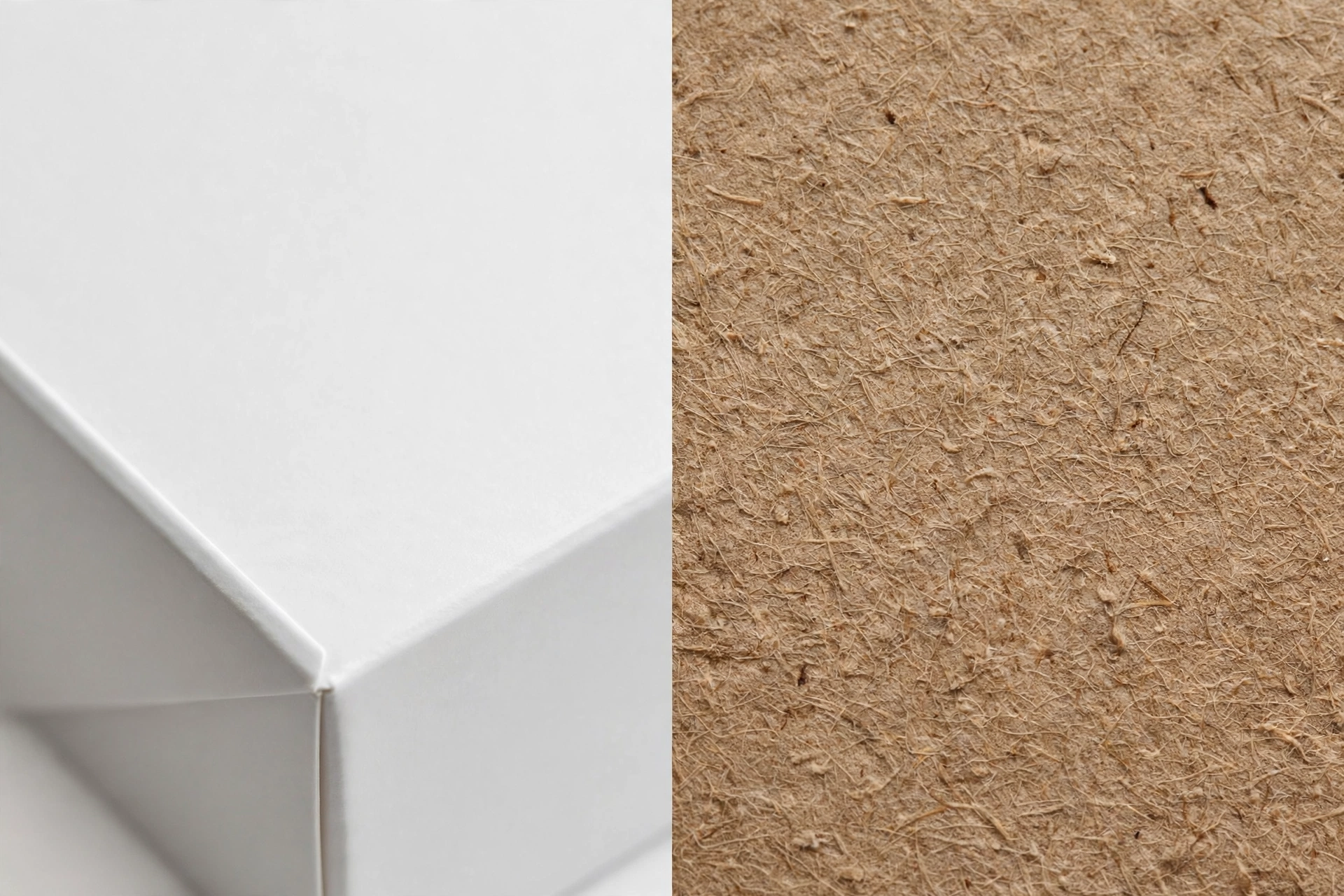
- Folding Boxboard (FBB / GC1 / GC2): Constructed with bleached chemical pulp outer layers sandwiching a mechanical pulp middle layer. GC1 features a double-coated top surface and a white pigmented reverse side; GC2 features a coated white top surface with a cream/manila reverse side. FBB yields higher bulk density ($1.3\text{ to }1.6\text{ cm}^3/\text{g}$) than SBS ($1.1\text{ to }1.3\text{ cm}^3/\text{g}$), delivering equal bending stiffness at roughly 12% to 18% lower grammage, representing substantial raw material savings.
Procurement Guidance: The standard sweet spot for retail folding cartons is 300 to 350 GSM. If your carton requires structural rigidity on automated high-speed packing lines, specify FBB GC1 with a verified Taber stiffness ≥ 14 mN (Machine Direction) per TAPPI T 489.
2. Greyboard (Solid Chipboard / Binders Board)
Greyboard is a heavy, multi-ply unlined board produced from 100% recycled waste paper (newsprint, corrugated clippings, and mixed office waste). It serves as the structural skeleton for luxury rigid set-up boxes (two-piece shoulder boxes, magnetic closure boxes, book-style presentation cases). Greyboard cannot be printed with fine graphics due to its rough, porous, grey fibrous surface. Instead, it is scored, V-grooved, folded into shape, and wrapped with 128–157 GSM printed coated art paper or specialty paper using animal gelatin or PVA adhesives.
Caliper Thresholds: Calipers range from 1.2 mm to 3.0 mm. For premium gift packaging, specify a minimum thickness of 2.0 mm (approx. 1,200–1,400 GSM). Calipers below 1.5 mm feel lightweight and prone to corner bowing; calipers exceeding 2.5 mm add significant container shipping weight without proportionate consumer benefit.
3. Coated Paper (C2S / C1S Art Paper)
Art paper consists of bleached chemical pulp coated on both sides (C2S) or one side (C1S) with mineral pigments (calcium carbonate and kaolin clay) bound with synthetic latex. It provides exceptional whiteness (>90% ISO), gloss, and smooth ink receptivity according to ISO 12647-2 litho-offset standards.
Conversion Risk: While 300–400 GSM coated art paper folds into small retail cartons (such as software or pharmaceutical boxes), the brittle mineral coating will crack along fold lines unless scored with precision counter-matrices. Applying a 12–15 micron BOPP film lamination (matte or gloss) is mandatory on all creased cartons to encapsulate the fiber fracture.
4. Kraft Paper & Kraft Board (SUS vs. Testliner)
Unbleached kraft board gets its name from the German word Kraft (strength), reflecting the chemical sulfate pulping process that preserves long, undamaged softwood cellulose fibers. It is naturally brown, exceptionally tear-resistant, and conveys immediate organic, sustainable branding.
- Solid Unbleached Sulfate (SUS / CUK): Virgin kraft board with extraordinary wet-strength and tear resistance. Extensively used for heavy beverage can 6-packs and frozen food transit shippers.
- Coated Kraft Back (CKB): Virgin kraft board featuring a clay-coated white top surface and a natural brown reverse, enabling full-color litho printing on the exterior while preserving natural kraft aesthetic on the interior.
- Testliner: Recycled brown linerboard used primarily in corrugated packaging. Possesses lower bursting strength (Mullen test) than virgin kraftliner.
5. Corrugated Board (Micro-Flute to Double-Wall)
Corrugated board combines one or two arched, fluted paper mediums bonded between flat linerboards. Stacking compression and crush resistance are governed by ISO 3037:2022 (Edge Crush Test - ECT) and FEFCO standards.
- E-Flute (~1.2 to 1.6 mm height; ~90 flutes/foot): The premier micro-flute for retail mailer boxes, subscription kits, and cosmetics. Provides superior crush resistance (>400 kPa) and a smooth printing surface with minimal flute washboarding.
- F-Flute (~0.75 to 0.90 mm height; ~125 flutes/foot): Ultra-micro-flute designed to replace solid folding cartons. Capable of being die-cut on standard carton folder-gluers, offering 40% higher compression stiffness than SBS board of equal mass.
- B-Flute (~2.5 to 3.0 mm) & C-Flute (~3.5 to 4.0 mm): Heavy industrial shipping shippers where stacking strength and impact absorption override retail aesthetics.
6. Specialty Paper
Specialty papers are niche cellulosic substrates engineered with distinct tactile textures, through-dyed pulp pigmentation, or embossed surface patterns (e.g., linen, buckram, felt, pearlescent mica coatings). Widely utilized as outer wraps for rigid gift boxes, luxury confectionery, and boutique cosmetic packaging. Because specialty paper costs 3× to 8× more than standard coated art paper, savvy buyers limit its use to decorative outer sleeves or belly bands paired with a standard white cardboard inner chassis.
7. Paper Honeycomb Board
Constructed by sandwiching a continuous hexagonal kraft paper core between two heavy kraftliner facings. Honeycomb board delivers extraordinary flat-crush resistance (exceeding 250 kPa) at minimal tare weight. With calipers ranging from 10 mm to 60 mm, it is strictly an industrial packaging material, replacing timber crates, EPS foam blocks, and wooden pallets for heavy machinery and solar panel transit.
8. Molded Pulp (Transfer-Molded Fiber)
Produced by immersing open wire-mesh molds into an aqueous slurry of recycled paper fibers or sugarcane bagasse, applying vacuum suction to draw fibers onto the screen, and drying under heated hydraulic press tools. Molded pulp provides three-dimensional nesting geometry, excellent shock absorption (G-force deceleration), and plastic-free positioning. While the fibrous surface cannot accept fine halftone printing, custom logos can be cleanly debossed directly into the tooling.
9. Duplex Board (White Lined Chipboard - WLC / GD2)
Duplex board with grey back (GD2) features a multi-ply construction: a bleached chemical pulp top ply with a single mineral blade coating, backing plies derived from mixed mechanical waste paper, and an unprinted grey recycled reverse. Representing the lowest-cost printable folding carton board on the market, it is widely utilized for footwear boxes, hardware, light bulbs, and commodity dry goods.
Buyer Caution: Because duplex board incorporates post-consumer recycled paper, its fiber length is degraded. Consequently, its Taber stiffness can vary by ±15% between mill production runs. It must never be used in direct contact with moist, fatty, or hot food due to mineral oil contamination risks.
10. Metallized Paperboard (Met-PET & Vapor-Deposited)
Engineered by laminating a microscopic, vacuum-aluminized polyester (PET) film (typically 12–15 µm) onto an SBS or FBB board base, or by applying direct vacuum metal deposition. It creates a mirror-like silver, gold, or holographic finish that enhances retail shelf visibility for premium cosmetics, spirits, and oral care. Converting metallized board requires specialized UV-curing inks and hybrid offline coating units, as conventional solvent- or water-based inks cannot penetrate the non-porous metallic surface barrier.
4. Structural Mechanics: Grain Direction & Crease Cracking
During automated paper machine fabrication, cellulose fibers naturally align parallel to the direction of web travel on the wire screen. This creates a distinct Grain Direction (Machine Direction - MD) and Cross Direction (CD):
- Stiffness Ratio: Bending resistance in the Machine Direction ($S_{\text{MD}}$) is typically 2.0 to 2.5 times higher than in the Cross Direction ($S_{\text{CD}}$). When designing folding cartons, the carton height (vertical axis bearing stacking load) must run parallel to MD to maximize top-to-bottom box crush resistance.
- Creasing and Scoring Dynamics: Folding paperboard against the grain ruptures cellulose bonds, resulting in jagged, cracked edges. Scores must be pressed with precision creasing rules. The width of the creasing channel in the counter-matrix is calculated using the standard packaging formula: $\text{Channel Width } (W) = 1.5 \times \text{Caliper } (T) + \text{Creasing Rule Thickness } (R)$
- Surface Tension (Dyne Level): For cartons requiring foil stamping, spot UV, or glue-flap adhesion, ensure the board surface maintains a dyne level of ≥ 38 to 42 mN/m. Lower surface energy causes carton adhesive seams to pop open during shipping.
5. Food-Contact Compliance: FDA, BfR & MOSH/MOAH
Paperboard boxes used for takeaway meals, baked goods, frozen foods, or confectionery must satisfy stringent legal food-safety criteria in the importing jurisdiction:
- United States FDA Standards: Compliant paperboards must adhere to 21 CFR 176.170 (substances safe for aqueous and fatty foods, requiring extraction tests with distilled water, ethanol, and heptane) or 21 CFR 176.180 (dry food contact).
- European Union Framework: Must comply with Regulation (EC) No 1935/2004 Article 3, ensuring no transfer of constituents harmful to human health. In the absence of a specific EU harmonized paper directive, German BfR Recommendation XXXVI serves as the de facto pan-European regulatory gold standard, restricting glyoxal, formaldehyde, and heavy metals.
- The MOSH/MOAH Contamination Hazard: Recycled duplex board contains residual printing inks from newsprint containing Mineral Oil Saturated Hydrocarbons (MOSH) and Mineral Oil Aromatic Hydrocarbons (MOAH). Under elevated temperatures, these volatile hydrocarbons vaporize and migrate into food. Consequently, European authorities prohibit un-barriered recycled fiber board for fatty or long-shelf-life food contact. Direct food packaging mandates 100% virgin chemical pulp (SBS or FBB) or a certified functional barrier coating.
- PFAS Restrictions: Under the adopted EU PPWR (Regulation (EU) 2025/40) Article 5, food-contact packaging cannot contain per- and polyfluoroalkyl substances (PFAS) above trace thresholds. EcoLeaderPack provides verified 100% PFAS-free barrier coatings for all food box programs.
6. EcoLeaderPack Custom Tissue Boxes & Cartons
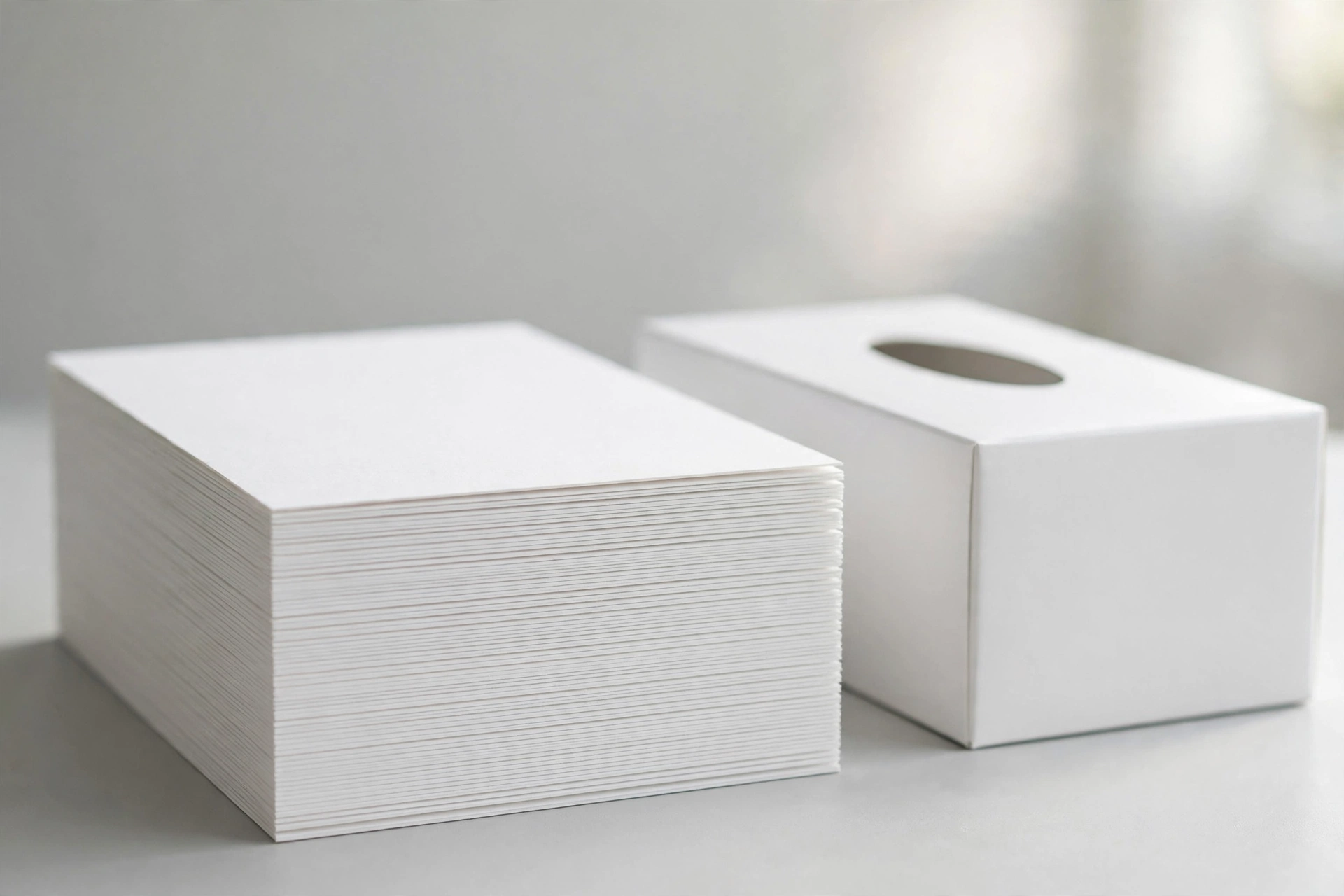
White cardboard (specifically 350 GSM Folding Boxboard GC1) is our core material of expertise. EcoLeaderPack manufactures and supplies complete, retail-ready custom tissue boxes engineered as integrated units: precision-printed carton chassis, high-speed automated carton erecting, custom tissue filling, and heavy export packaging under single-source accountability.
Custom Branded Tissue Boxes via EcoLeaderPack Custom Packaging
Manufactured using 350 GSM virgin FBB board with precision die-cut dispensing apertures, dust flaps, and full-color CMYK litho print. Formats include standard rectangular, cube, kraft, sleeve, and car canister structures.
Explore custom tissue boxesTakeaway Food Boxes & Cartons
Grease-resistant virgin kraft and white cardboard folding cartons certified for direct food contact. Includes lunch boxes, noodle pails, sushi containers, and bakery boxes with leak-proof webbed corner closures.
Browse paper packaging boxes- Substrate Engineering: 350 GSM virgin wood-pulp FBB (GC1) with high Taber stiffness (≥15 mN MD) ensuring the box retains crisp rectilinear corners without bowing.
- Facial Tissue Fill: 2-ply to 4-ply virgin wood-pulp paper sheets (13.5 to 15.0 GSM per ply) with custom embossing patterns, bamboo pulp options, or lotion infusions.
- Surface Finishes: High-speed litho-offset printing with Pantone spot matching, matte/gloss dispersion varnishes, soft-touch lamination, hot foil stamping, and tactile multi-level embossing.
- Commercial Terms: Flexible production MOQ starting at 5,000 units per artwork; 5-day pre-production prototyping; 15 to 20-day mass production cycle.
7. Sourcing Decision Framework: 5 Buyer Questions
Work through these five technical criteria to pinpoint the exact paperboard grade for your project:
- What is the product mass and transit stress?
- Under 500 g → 250–300 GSM White Cardboard (FBB) or Coated Art Paper.
- 500 g to 2.5 kg → 350–400 GSM FBB, or micro-flute (E-flute / F-flute) corrugated board.
- Over 2.5 kg or fragile luxury → 2.0 mm+ Rigid Greyboard wrap or B/C-flute corrugated shippers.
- What are the graphical and decoration demands?
- Photorealistic halftone images → Double-coated FBB, SBS, or C2S Art Paper.
- Natural, rustic eco-branding → Unbleached Virgin Kraftboard (SUS).
- High-impact luxury shelf presence → Metallized Paperboard (Met-PET) or through-dyed Specialty Paper.
- Will the board make direct contact with food?
- Yes, aqueous or fatty foods → 100% virgin SBS or FBB certified to FDA 21 CFR 176.170 / BfR XXXVI with water-based barrier coating.
- Yes, dry bakery → Virgin Kraft or FBB certified to FDA 21 CFR 176.180.
- Never use standard recycled duplex board for direct food contact.
- What are the automated packing line constraints?
- High-speed erect-and-fill machines demand high-bulk FBB with low caliper variance (±3%) and precise grain direction to prevent line jams.
- What is the landed packaging budget?
- Price-sensitive non-food cartons → Duplex Board with grey back (GD2).
- Mid-market retail folding cartons → Folding Boxboard (FBB GC1/GC2).
- Premium keepsake boxes → Wrapped Rigid Greyboard.
8. Frequently Asked Questions
What is the difference between SBS and FBB paperboard?
Solid Bleached Sulfate (SBS) is composed of 100% bleached chemical virgin pulp throughout all plies, delivering a bright white appearance on both sides, exceptional purity, and superior tear strength. Folding Boxboard (FBB) uses bleached chemical pulp on the outer layers with a mechanical pulp core. FBB provides higher bulk density, delivering equivalent bending stiffness to SBS at approximately 15% lower grammage and reduced raw material cost.
Why does coated art paper crack along the score lines when folded?
Coated art paper features a heavy mineral pigment layer (kaolin clay and calcium carbonate) that lacks flexibility. When folded sharply, the brittle mineral surface fractures. To prevent cracking, the board must be creased with a calibrated matrix rule parallel to fiber grain direction, and laminated with a thin BOPP film to encapsulate the surface fibers.
Can duplex board with grey back be used for food packaging?
Duplex board with grey back (GD2 / WLC) is made from recycled mixed paper waste and contains residual mineral oils (MOSH/MOAH) from newspaper printing inks. It cannot be used in direct contact with moist, fatty, or long-shelf-life foods under European (BfR XXXVI) and US regulations. It is only permissible as an outer secondary packaging box where food is sealed inside a primary impermeable pouch.
What thickness of greyboard is recommended for luxury rigid boxes?
For high-end gift sets, cosmetics, and electronics rigid set-up boxes, a greyboard thickness of 2.0 mm (approx. 1,200–1,400 GSM) is the industry standard sweet spot. Boards below 1.5 mm feel flimsy and can warp, while boards exceeding 2.5 mm add unnecessary shipping mass.
What does E-flute corrugated board offer compared to standard folding boxboard?
E-flute corrugated board has a thickness of approximately 1.2 to 1.5 mm with roughly 90 flutes per foot. It provides substantially higher stacking crush resistance and cushioning than solid paperboard of equal weight, making it the preferred choice for e-commerce mailer boxes and heavy retail items.
What documents must a factory provide to verify food-grade paperboard?
For the United States market, request third-party extraction test reports verifying compliance with FDA 21 CFR 176.170 / 176.180. For the European market, request a Declaration of Compliance (DoC) under Framework Regulation (EC) No 1935/2004 citing conformity with German BfR Recommendation XXXVI and heavy metal screening per Directive 94/62/EC.
Request Custom Paper Packaging Box Samples or a Bulk Quotation
EcoLeaderPack supplies custom paperboard packaging boxes, tissue boxes, and food containers to global retail brands and foodservice operators. Share your target dimensions, required board grade, estimated quantity, and destination market below. Our packaging engineering desk will review your specifications and provide a comprehensive quotation within 24 business hours.
Request a Paperboard Packaging Quote
Direct manufacturer supply with certified ISO and food-contact compliance. Submit your project requirements below.